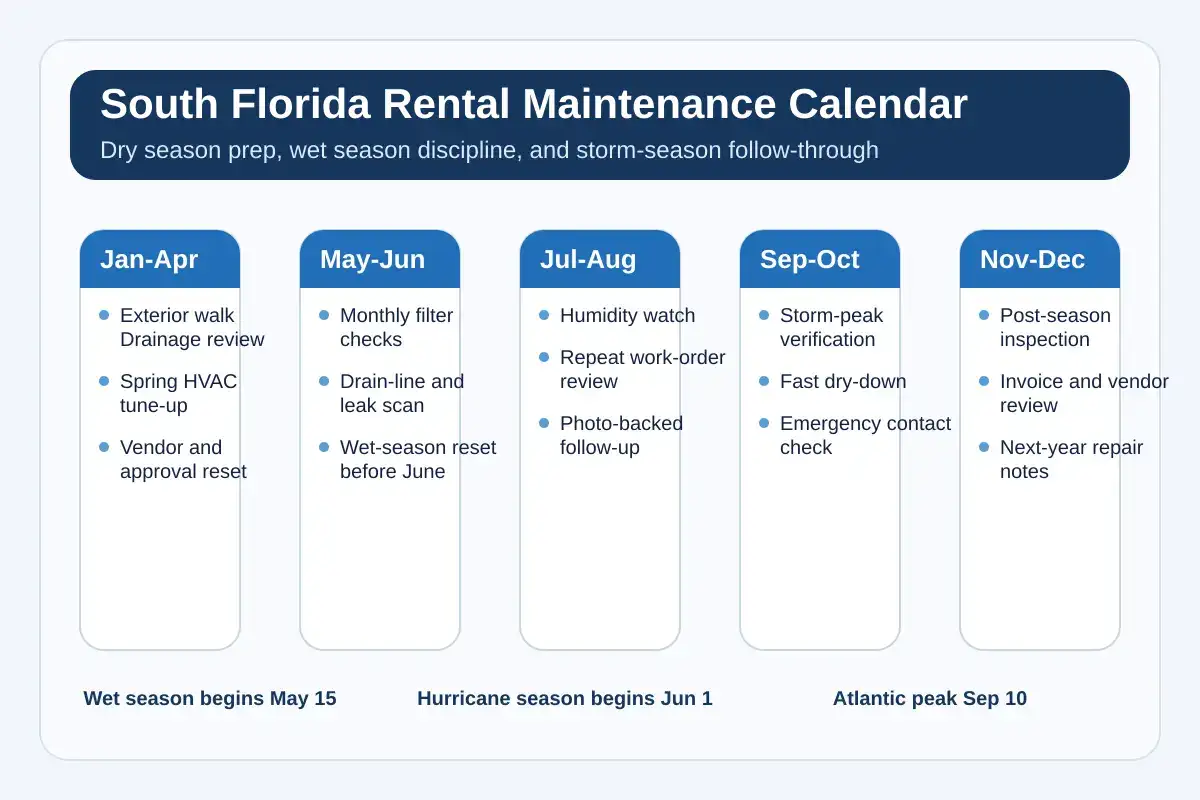
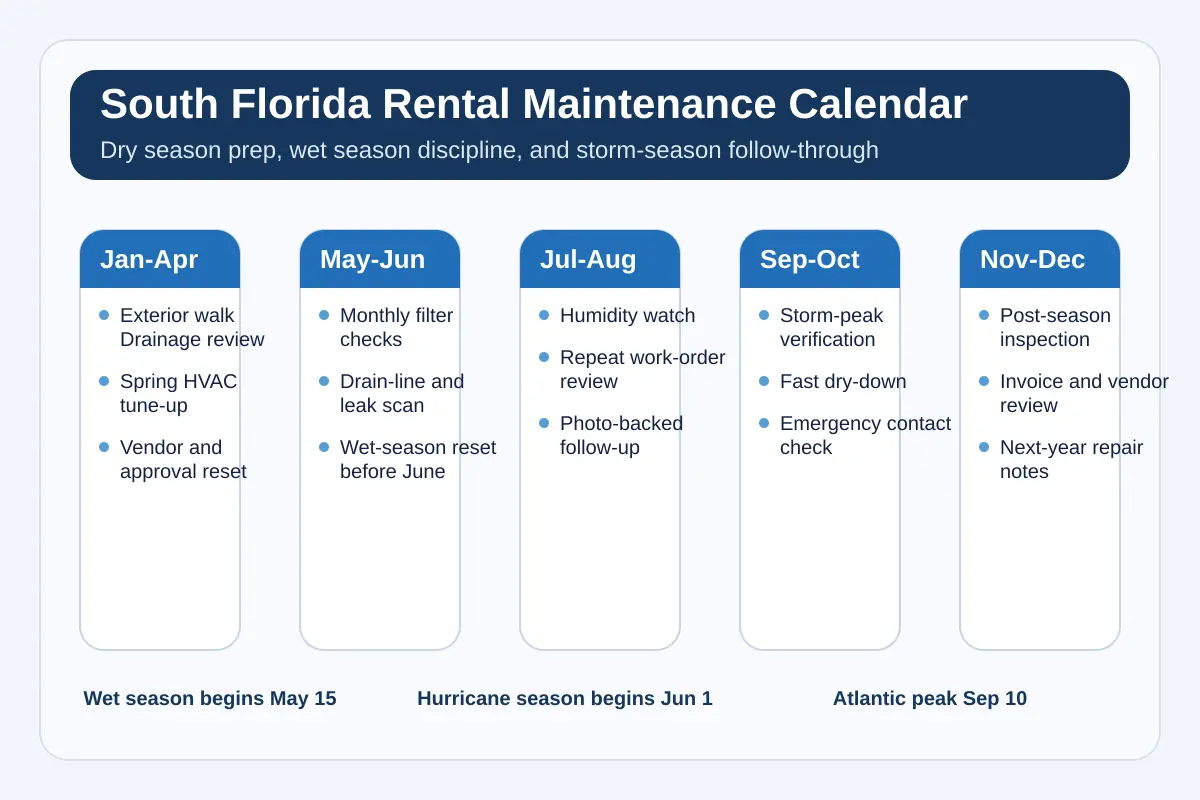
 South Florida rentals do not need the same maintenance rhythm as a dry-climate property. The useful calendar is built around moisture, storm timing, and the service delays that appear when everybody waits until the same week to act.
A South Florida rental maintenance calendar should be driven by weather windows, not by generic quarterly reminders copied from a national checklist. The National Weather Service treats May 15 through October 15 as South Florida's wet season, and the National Hurricane Center says the Atlantic hurricane season runs from June 1 through November 30, with the seasonal peak around September 10. If you own rentals in Miami-Dade, Broward, or Palm Beach, those dates should shape when you inspect, schedule, document, and follow up.
That is also why Incubate PM's maintenance coordination page reads differently than a generic handyman pitch. It frames maintenance around humidity, salt air, clogged AC drains, and fast triage through a documented portal workflow. Pair that with the broader property management message - protect cash flow, reduce vacancy, and keep small problems from becoming claims - and the right calendar becomes obvious: do more before the weather turns, not after.
If your bigger question is who should do the work once it is identified, Incubate's South Florida rental maintenance decision guide is the better companion read. This page is about when those tasks belong on the calendar.
This guide is written for South Florida rental owners who want a cleaner month-by-month operating plan. It is general educational information, not legal, insurance, electrical, roofing, or contractor advice for a specific property.
Why a calendar beats a reactive maintenance list
Reactive maintenance always feels cheaper right up until it is not.
The first mistake is assuming all climates punish delay the same way. South Florida does not. Incubate's maintenance page says sun, humidity, and salt air all accelerate wear, and it calls out minor leaks and clogged AC drains as issues that can snowball into major claims when they are ignored. Its rental-property-owners hub makes the owner side of that problem even clearer: midnight maintenance calls, vendor hunting, and scattered follow-up are some of the reasons landlord stress turns into vacancy and cash-flow drag.
A calendar solves that by forcing two questions earlier in the year:
- What needs to be handled before moisture and storms raise the stakes?
- What has to be checked again while the season is still active, not only after the damage is obvious?
That is also where a calendar beats a static checklist. A checklist tells you what exists. A calendar tells you when delay becomes expensive.
The two weather windows that should drive the whole year
Owners do not need to memorize every weather bulletin, but they should organize the year around two official windows.
| Window | Official source | Why it matters for maintenance |
|---|---|---|
| May 15 to October 15 | National Weather Service Miami wet-season outlook | This is the period when 60 to 70 percent of South Florida's yearly rainfall typically occurs, with high moisture and frequent thunderstorms. |
| June 1 to November 30 | National Hurricane Center Atlantic climatology | This is the official Atlantic hurricane season, with most activity between mid-August and mid-October and a peak around September 10. |
Those dates tell you when roof edges, drainage, seals, AC drains, moisture complaints, and vendor availability become more sensitive. They also help you stage HVAC work more intelligently. ENERGY STAR says cooling systems are best checked in the spring and heating systems in the fall, before contractors are swamped. In South Florida, that spring check is the more urgent one because the cooling system and humidity load will do most of the work.
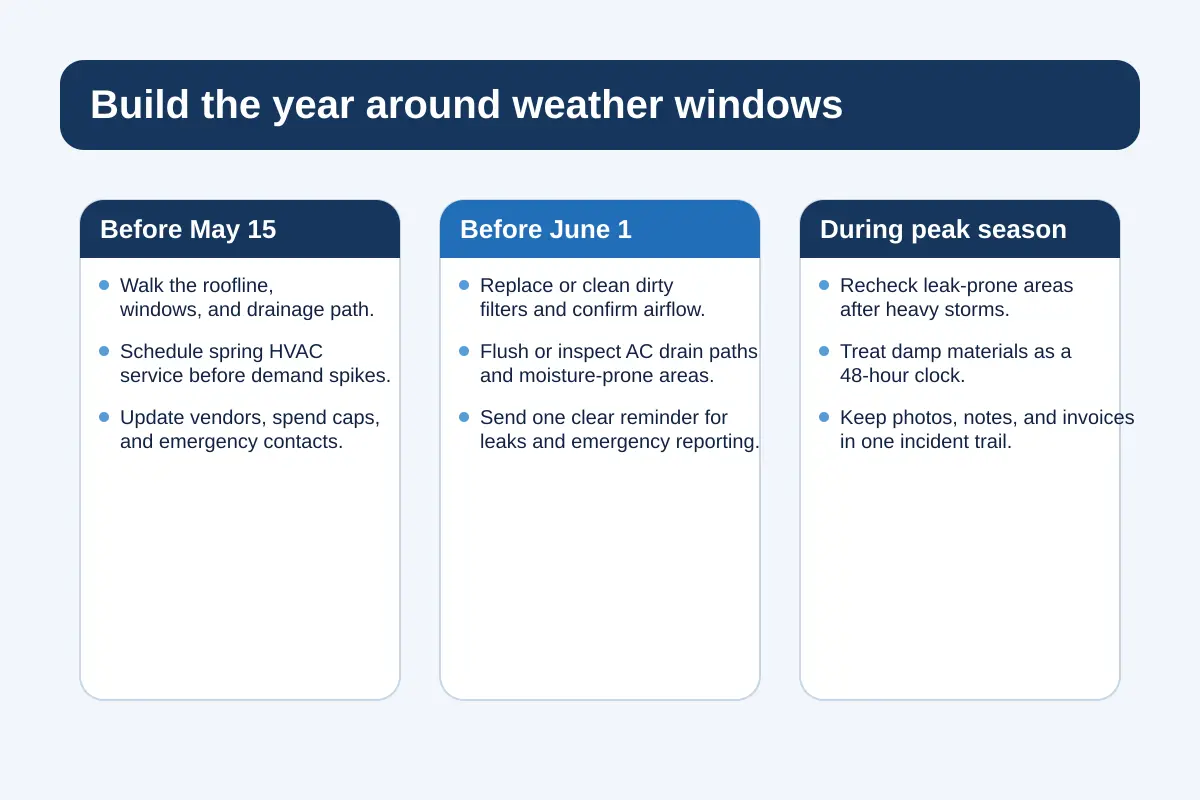 The useful maintenance calendar has three pressure points: before the wet season starts, before hurricane season settles in, and again as the Atlantic season reaches its climatological peak.
January through April: dry-season inspection and vendor planning
The dry season is the quietest time to find what summer will punish.
Start with the exterior and the water path. Look for cracked sealant, roof-edge wear, ponding patterns, staining near soffits, door and window gaps, and any grading or drainage issue that already shows up after an ordinary rain. You are not trying to solve every capital project in one quarter. You are trying to identify the items that will become less forgiving after May.
This is also the best time for the main HVAC and vendor reset. ENERGY STAR recommends spring pre-season service, and South Florida owners should treat that as more than a tune-up. Ask whether the drain path is clean, whether the filter schedule still makes sense for the unit, and whether anything about the current equipment makes humidity control weaker than it should be. Incubate's maintenance page specifically recommends regular filter changes and drain-line flushes. That is a local clue, not generic filler.
A productive January-through-April block usually includes:
- one exterior walk focused on drainage and envelope weak spots
- one HVAC service visit scheduled before summer demand spikes
- one update to vendor contacts, approval thresholds, and after-hours instructions
- one review of prior work orders so repeat issues are not treated like random bad luck
If you use a manager, this is also the right season to pressure-test the workflow. Incubate's owners page says owners can review and approve work orders, inspection photos, and monthly statements in the portal. That matters because a maintenance calendar only works when the records are easy to retrieve later.
May through June: reset the moisture and HVAC basics before wet season bites
May 15 is the wet-season line, and June 1 starts the Atlantic hurricane season. Those are not symbolic dates. They are maintenance deadlines.
Once the wet season starts, small water problems get less patient. The National Weather Service describes this window as consistently high-moisture season with frequent storms. EPA's mold guidance adds the building-science consequence: moisture control is the key to mold control, indoor humidity should stay below 60 percent when possible, and wet or damp areas should be cleaned and dried within 48 hours. Waiting to see whether a damp spot solves itself is not a serious plan.
This is the point in the year when monthly filter discipline matters most. ENERGY STAR says to check the air filter once a month and clean or replace it if it is dirty. In South Florida rentals, that recurring check is tied to comfort, airflow, and moisture control at the same time. If the unit already struggles in the shoulder months, summer will not improve the situation.
Before June is fully underway, owners should aim to finish:
- filter check or replacement for each active system
- drain-line inspection or flush per the maintenance plan
- gutter and drainage cleanup where applicable
- quick leak scan around air handlers, water heaters, windows, and prior problem areas
- tenant reminder about how to report moisture, leaks, or emergency maintenance quickly
This is also a good time to revisit Incubate's live South Florida rental hurricane season checklist as a storm-specific companion. That article is useful for records and communication. This page is the broader year-round calendar that should make the storm checklist easier to execute.
July through August: stay ahead of humidity, leaks, and mid-summer wear
The most expensive summer maintenance issue is often the one that looks too small to escalate.
July and August are when owners start getting tempted to normalize condensation, musty smells, minor staining, slower cooling, and recurring tenant complaints. That is exactly the wrong habit. EPA says regular building and HVAC inspections help catch moisture problems before they become mold problems, and its guidance says to dry wet areas quickly instead of letting damp materials sit.
A mid-summer review does not need to be dramatic. It needs to be disciplined. Focus on the problems South Florida weather tends to magnify:
- filters that loaded up faster than expected
- drainage or downspout patterns that only fail during heavy rain
- repeat work orders tied to one room, one wall, or one appliance zone
- AC performance complaints that may actually be airflow or moisture complaints
- ceiling stains or trim swelling that can be photographed, logged, and compared later
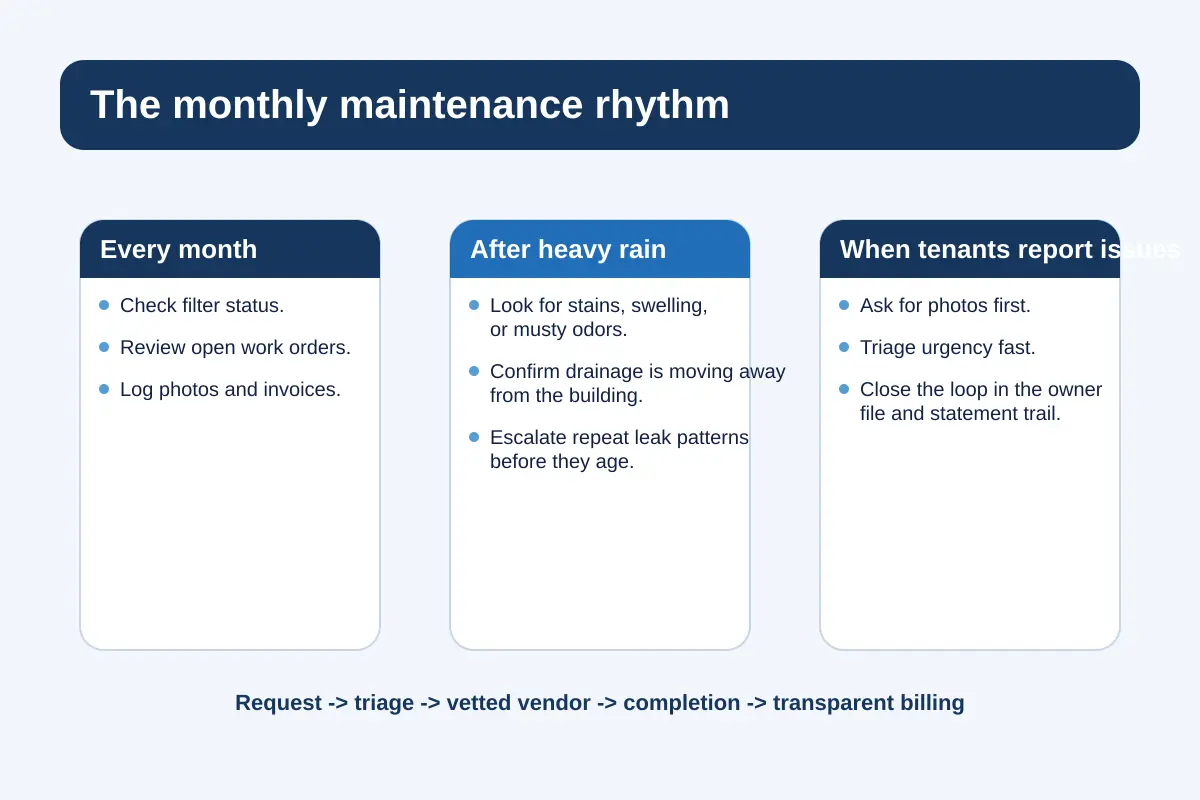 Summer discipline is not about adding busywork. It is about shortening the time between a small symptom, a photo-backed report, and a documented fix before the unit drifts toward mold, tenant friction, or vacancy risk.
This is also where documentation earns its keep. Incubate's maintenance workflow says tenants submit requests with photos, the team triages urgency, dispatches the right vendor, and keeps invoicing visible. That is the right model even if you self-manage. A recurring summer issue should never live only in memory.
September through October: treat peak storm season as a maintenance deadline
The National Hurricane Center says the Atlantic season peaks around September 10, with most activity concentrated between mid-August and mid-October. Owners should treat that as a maintenance deadline, not as trivia for weather enthusiasts.
By this point in the year, the main value is not discovering new tasks. It is verifying that the obvious tasks were actually finished and that nothing from the summer was left half-resolved.
Use this window to confirm:
- known leak areas really stayed dry after recent storms
- roof, window, or drainage fixes were completed instead of only quoted
- emergency contacts and vendor notes are still current
- tenants know the reporting channel for urgent water or electrical issues
- owner approval steps will not slow down stabilization work if a storm-related event occurs
Post-storm follow-up matters just as much as pre-storm prep. If a unit takes on water, EPA's moisture guidance is the useful line in the sand: dry wet or damp areas within 48 hours when possible and address the moisture source, not just the visible effect. Painting over a recurring stain or running one fan for a few hours is not the same as closing the loop.
This is also the part of the year when a good property manager looks less like a vendor and more like an operating system. Incubate's property-management page frames the job around cash flow, maintenance, tenant communication, and 24/7 support. In storm season, that translates into faster routing, cleaner records, and fewer situations where the owner is reconstructing the event from scattered texts after the fact.
November through December: close the loop after the wet season
Once the wet season eases, owners get one of the best maintenance opportunities of the year: the chance to learn from what just happened before the next cycle begins.
November and December are ideal for post-season closeout. Review the work orders that repeated, the vendors that were slow, the approvals that created friction, and the units that handled weather worst. If one building or one property had repeated AC drain, window, or moisture complaints, next year should not start from zero.
This is also the moment to connect maintenance to turnover planning. Incubate's property-management and owner pages both frame vacancy as a financial problem, not just a leasing inconvenience. If a system issue, finish issue, or moisture history is likely to affect the next lease-up, year-end is the time to budget it properly instead of discovering it during a rushed make-ready window.
A solid November-through-December closeout includes:
- one post-season inspection of known problem spots
- one file cleanup so invoices, photos, and summaries are easy to compare next year
- one vendor scorecard update based on responsiveness and quality
- one budget note on the repairs or replacements that should move before next summer
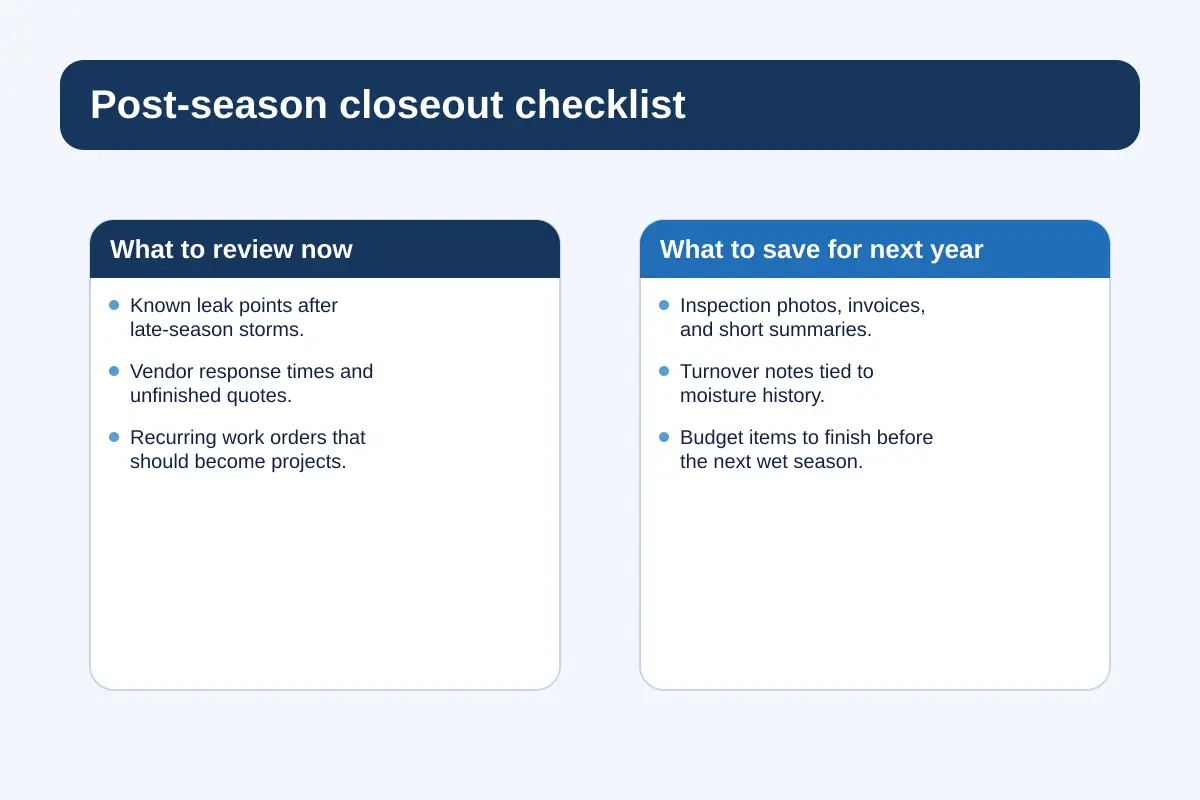 Year-end closeout is where a maintenance calendar becomes smarter from one season to the next. The goal is not perfect memory. It is better systems before the weather resets the test.
A monthly owner checklist that protects occupancy
If you want the short version, use this rhythm every month and intensify it during wet-season months:
- Check the HVAC filter status. ENERGY STAR's monthly reminder is simple because it works.
- Review open work orders. Do not let a repeat moisture complaint age into a larger repair.
- Look for visible water clues. Ceiling stains, trim swelling, musty odor, and window condensation patterns all deserve a note.
- Confirm photo-backed documentation. Every meaningful issue should have a record.
- Compare this month to last month. If the same unit or vendor keeps appearing, the pattern matters.
- Update the owner file. Statements, invoices, and follow-up notes should be easy to retrieve.
- Pressure-test the next weather window. Ask what becomes harder if you wait another 30 days.
That last question is the one most owners skip. It is also the one that keeps occupancy losses from getting more expensive than the repair itself.
How Incubate's workflow changes the outcome
What Incubate sells on this topic is not only vendor access. It is structure.
Its maintenance page describes portal-based request intake, triage, vetted vendor dispatch, and transparent billing. Its owners page adds work-order approvals, inspection photos, and statement access. Its rental-owner page frames the wider owner problem honestly: late-rent stress, legal complexity, maintenance emergencies, and the time drain of trying to manage everything ad hoc.
That combination matters because a calendar without a workflow still breaks down under pressure. The practical advantage of a management system is that it gives each calendar task somewhere to live:
- the spring HVAC check becomes a documented service record
- the summer leak report becomes a photo-backed work order
- the September storm follow-up becomes a traceable incident file
- the November closeout becomes next year's maintenance note instead of a forgotten lesson
If you want to compare your current process against that standard, start with Incubate PM's maintenance coordination service description and owners page, then use the contact page if you want help pressure-testing your current workflow.
This article is general educational information only. Weather risk, building systems, leases, insurance obligations, electrical conditions, and repair scope vary by property, so confirm important decisions with qualified professionals and the relevant official sources before acting.