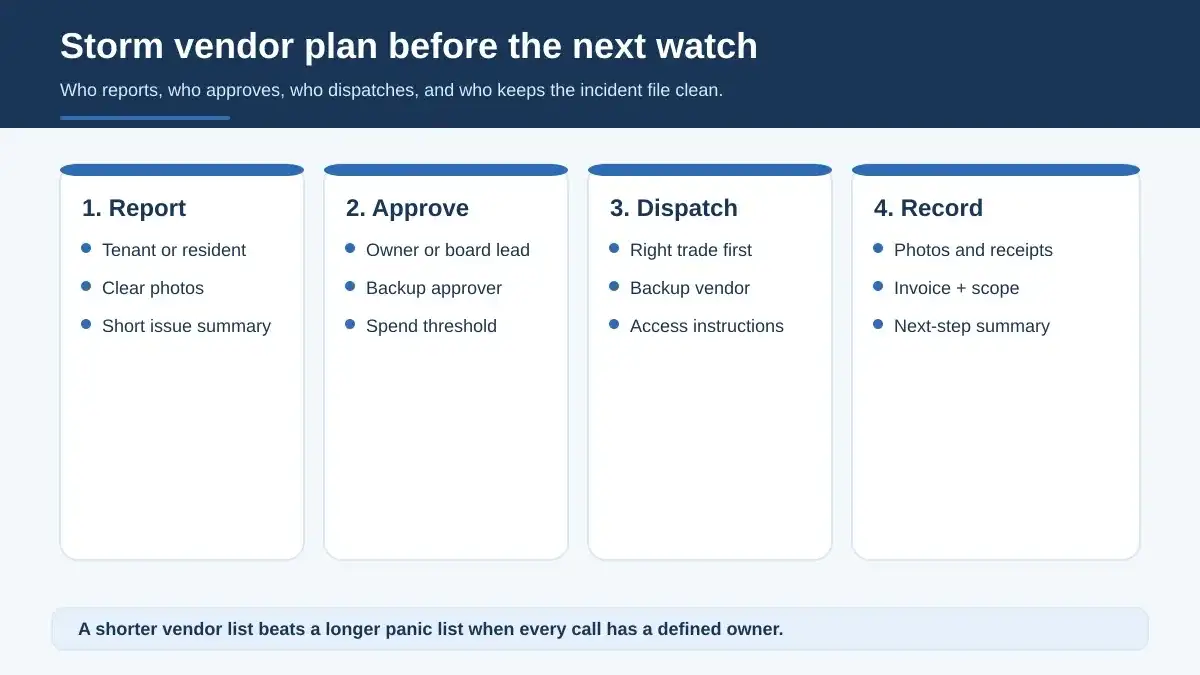
A hurricane vendor list for property management is not really a list problem. It is a workflow problem.
Most owners and boards do not forget that storms happen. What they forget is how many small decisions must line up once a watch or warning gets close: who can approve a roof tarp, who calls the plumber versus the water-mitigation crew, who has gate codes, who is collecting photos, and who is making sure the final invoice still ties back to one clean incident file.
Ready.gov says Atlantic hurricane season runs from June 1 through November 30 and urges people to make a plan, review important documents, and strengthen the property before a storm is close. Incubate PM's maintenance coordination page gives the property-management version of that advice: requests come in with photos, urgency is triaged, the right vendor is dispatched, and owners can follow the work through a documented portal workflow instead of scattered texts.
That is the lens for this guide. It is not a public directory of vendors and it is not legal, insurance, or construction-contract advice. It is a practical operating plan for rental owners and association boards that want cleaner first calls, cleaner approvals, and cleaner records when South Florida weather stops being theoretical.
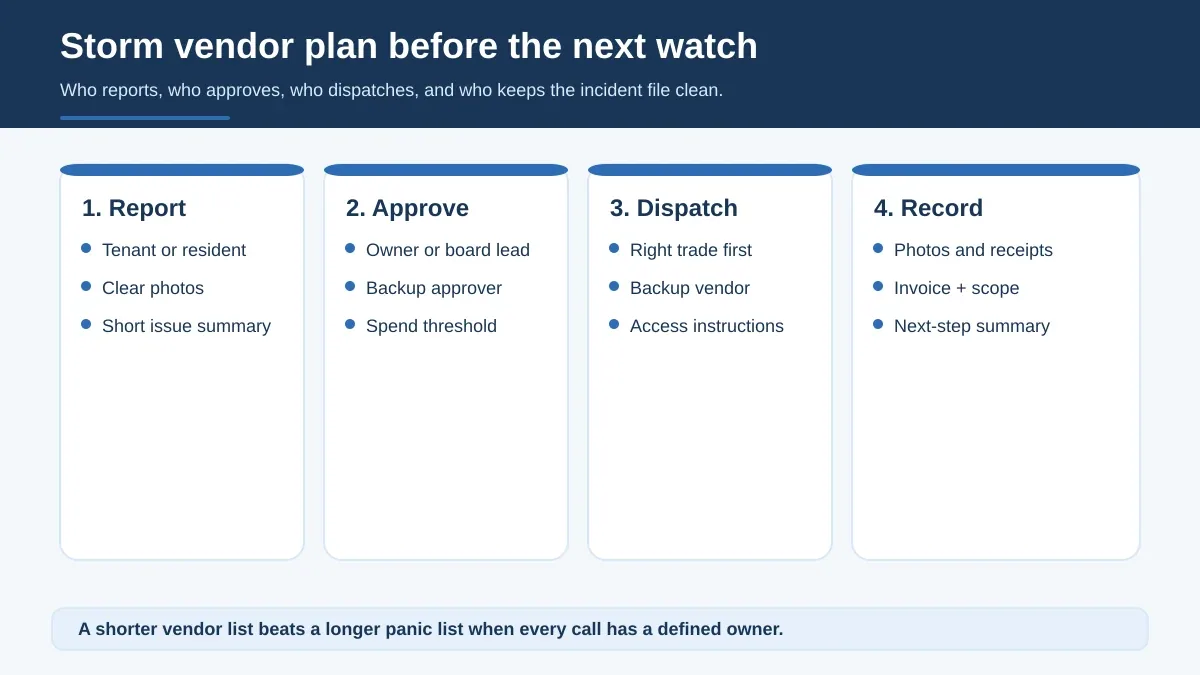 The useful hurricane vendor plan is not just names and numbers. It is a clear command chain for who calls, approves, dispatches, documents, and follows up.
Why hurricane vendor plans fail before the storm, not after landfall
When storm prep goes badly, the failure usually starts before the weather event itself.
The owner may have a roofer saved in one phone, a plumber saved somewhere else, and no backup contact for after-hours approvals. A condo board may know which vendors it has used before, but not who can authorize urgent common-area work when a property manager, president, and treasurer are all waiting on each other. Tenants or residents may know how to report a problem, but not what kind of photos make triage faster.
That is why Ready.gov's planning guidance matters more than it first appears. The agency is not only telling people to buy supplies. It is telling them to make an emergency plan, review documents, and prepare the property while there is still time to think clearly. In a managed property context, that means a storm file should already answer questions like:
- Which vendor categories are pre-cleared for first-call work?
- Who can approve emergency stabilization without a long email chain?
- Where do access notes, prior repair photos, and property-specific warnings live?
- How will tenants, owners, board members, and vendors all see the same status updates?
Incubate's own service pages support that operating model. Its maintenance page says requests are submitted with photos, the team assesses urgency, and the appropriate vetted vendor is dispatched. Its owners portal page adds the oversight piece: owners can review and approve maintenance work orders, view inspection photos, and download invoices and statements in one place. Those details matter because storm response slows down fast when the communication system is improvised.
Which vendors belong on the pre-storm list
The right vendor list is shorter and more deliberate than many people expect. You do not need fifty names. You need the contractor lanes most likely to protect the asset in the first hours and first days after wind or water shows up.
For most rentals and associations, the core list usually includes:
| Vendor lane | Why it belongs on the short list | What to confirm before weather tightens |
|---|---|---|
| Roofing / building envelope | Fast temporary protection can prevent a manageable leak from spreading through finishes or common areas | Primary contact, backup contact, service area, and whether emergency stabilization is available |
| Plumbing / leak-source diagnosis | Water often has to be isolated or traced quickly before anyone can decide on drying scope | Dispatch process, property access notes, and whether the trade handles emergency calls directly |
| Water mitigation / dry-out | EPA says water-damaged areas should usually be dried within 24 to 48 hours to help prevent mold growth | Response expectations, photo/documentation habits, and where moisture readings or progress updates will be stored |
| Electrical / HVAC | Wet electrical conditions and storm-related equipment failures create safety and habitability issues fast | Emergency number, building access needs, and whether the trade can coordinate with other vendors |
| Debris, gates, exterior access, or other property-specific trades | Associations and larger properties often need help clearing access routes or restoring entry systems before routine repairs can move | Which trade owns the first call, who approves it, and whether another specialist must follow |
That last row is where asset type matters. A single rental home, a mid-rise condominium, and an association with shared equipment do not need the exact same list. Incubate's condo association management page makes that clear by framing condo operations around complex infrastructure, large-scale maintenance projects, vendor oversight, and high-density communication. A vertical building may need access-control, common-area, or building-systems coordination that a single-family rental does not.
One useful detail from the Incubate owner resources page is financial, not technical: the fee table says maintenance coordination dispatch is usually included, while vendor invoices pass through, and owners should ask about after-hours surcharge policies. That is exactly the kind of detail people get annoyed to learn too late. If your storm plan involves management coordination, know ahead of time what is included, what still passes through as vendor cost, and what changes when the call comes in at night or over a weekend.
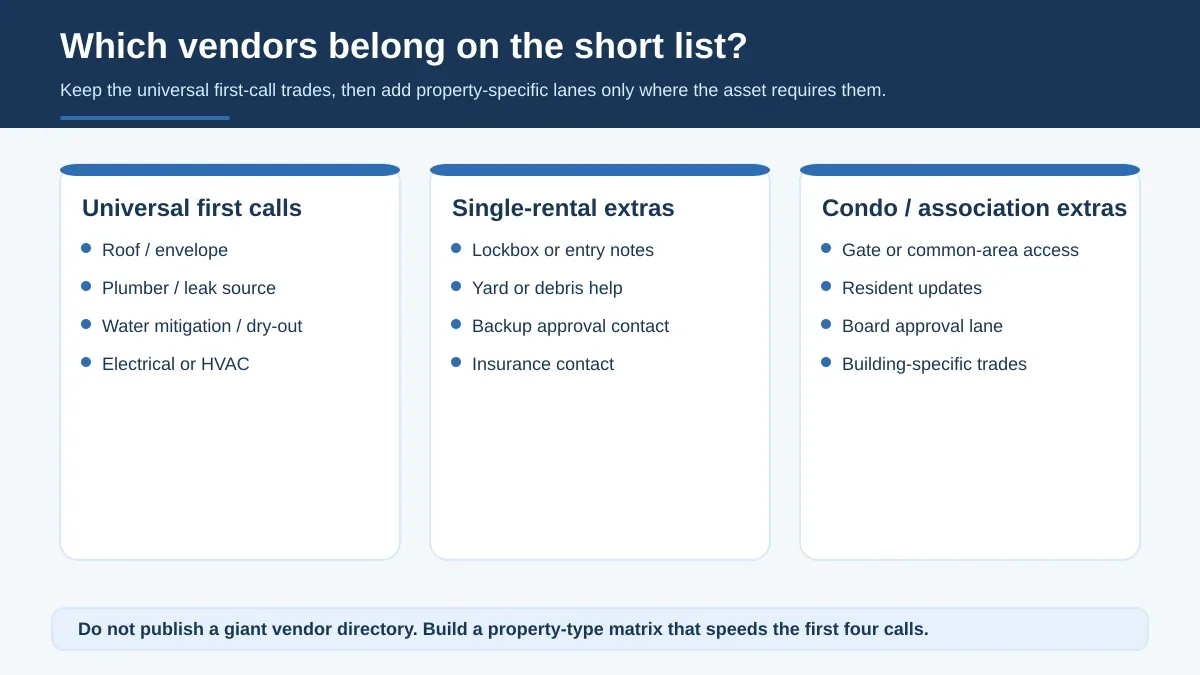 A useful storm vendor list separates universal first-call trades from property-specific trades that depend on whether you manage a house, condo, or association asset.
How approval chains should work for owners, boards, and managers
Vendor readiness is only half the problem. The other half is approval latency.
In real storm conditions, properties do not lose time because nobody cares. They lose time because the wrong people have to bless small emergency steps that should already have a path.
For rental owners, the cleanest version is usually straightforward:
- define who can approve urgent stabilization work if the primary owner is unavailable
- define what information must accompany the request before approval is expected
- define how the vendor update comes back into one record after the visit
For association boards, the chain is usually a little more layered. Incubate's condo page highlights board advisory support, official record maintenance, resident communication, and vendor oversight for exactly this reason. Shared systems, common areas, and resident expectations make it harder to rely on a single informal phone tree. A board should know in advance who is authorized to approve emergency first steps, who communicates with residents, and who is collecting the supporting records.
The manager's role should be traffic control, not extra bureaucracy. Incubate's maintenance workflow says the team triages the request, dispatches the appropriate vetted vendor, verifies the work, and handles invoicing transparently. In a storm workflow, that translates into a manager who keeps four things moving at once:
- the first report with photos
- the dispatch decision
- the approval or acknowledgment chain
- the incident log with vendor updates attached
If those steps live in different channels, the property gets slower every hour.
That is also why the owner portal matters. Incubate says owners can review maintenance work orders, inspection reports with photos, monthly statements, and invoices through the portal. In a storm workflow, that kind of visibility is not just a nice dashboard feature. It is what keeps the approval chain short enough to be useful.
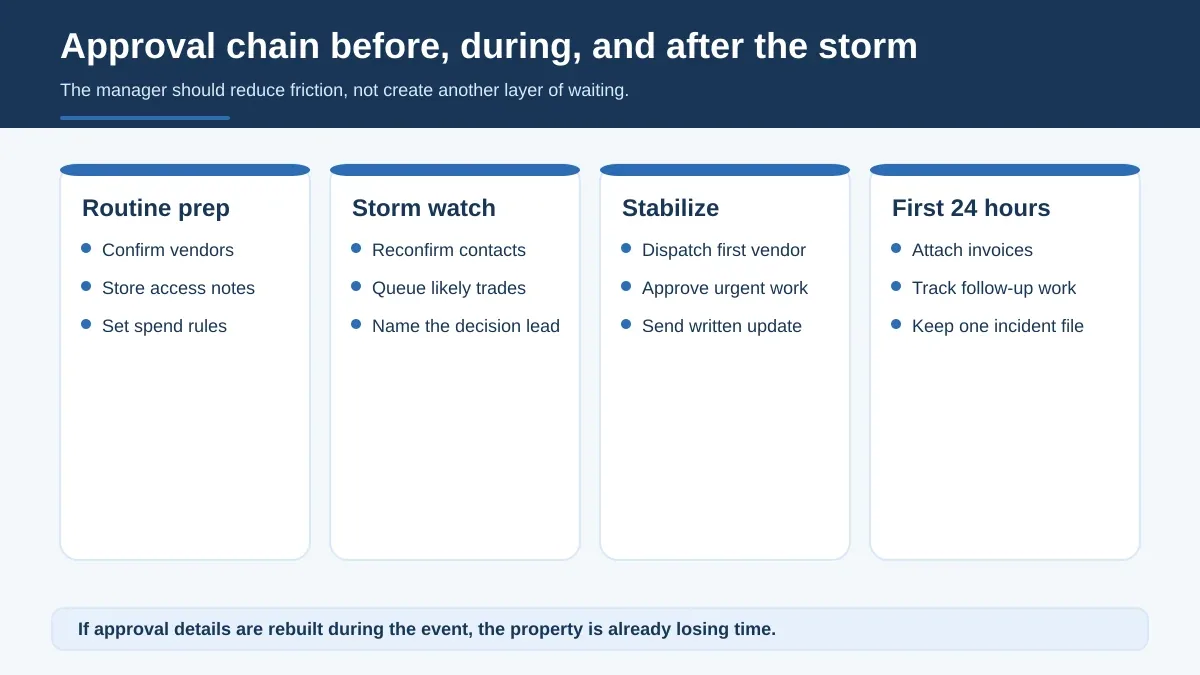 Good approval chains remove drama from the first decisions: who can greenlight stabilization, who gets informed, and where the work record lives afterward.
What to document before and after cleanup starts
Vendor lists work better when the supporting file is already built.
Ready.gov's recovery guidance says to document damage before cleanup, take photos, make a list, and save all receipts for repair and cleanup. Ready.gov's hurricane page adds that people should review important documents before a storm and document property damage with photographs afterward. EPA adds the moisture-control deadline many owners underestimate: dry water-damaged areas and items within 24 to 48 hours in most cases to help prevent mold growth.
Put together, those sources point toward a practical storm vendor file with two layers.
Before the storm
- current property photos or recent condition notes
- vendor contact sheet with primary and backup numbers
- access details such as gate instructions, lockbox notes, parking, or loading limitations
- approval tree with primary and backup decision-makers
- insurance and ownership contacts stored with the property record
After the storm
- wide and close damage photos before cleanup changes the scene
- the first written incident summary with date and time
- work orders, invoices, and receipts tied to each visit
- notes on what was stabilized versus what still needs follow-up
- drying, mitigation, or reinspection proof where water intrusion occurred
This is also where EPA's guidance helps keep the workflow honest. The agency says the key to mold control is moisture control, and that if you clean up mold without fixing the water problem, it will likely return. So the file should not only prove that someone showed up. It should prove that the water path was addressed and that the property moved from emergency response into actual recovery.
How to avoid rushed contractor mistakes after the storm
One of the best South Florida-specific sources for this topic is Miami-Dade County's Warning Signs When Hiring Contractors.
The county warns that the aftermath of a hurricane attracts unscrupulous and unlicensed contractors, and it gives a concrete checklist that property owners should care about:
- verify that the contractor has a valid license
- ask for proof of insurance
- get the terms in writing
- obtain more than one estimate
- confirm who is responsible for the permit
- avoid large upfront payments that are out of proportion to the work completed
- do not make final payment until proof of final inspection is provided
That is the difference between a storm vendor plan and a panic purchase.
Incubate's maintenance page says the company uses a curated list of reliable, licensed, and insured local contractors rather than random handymen. Even if you already use a manager with that kind of network, Miami-Dade's warning is still useful because it clarifies what "vetted" should mean in practice. It should mean you can verify licensure, insurance, written scope, and who is actually responsible for permit and inspection compliance if the work requires it.
If you self-manage, this is the moment to remove guesswork before the emergency:
- save the official verification path for licenses and complaints
- record which vendors have worked on which property type
- keep backup options for the trades most likely to be overloaded
- decide how a rushed doorstep offer will be evaluated before anyone is tempted to say yes on emotion alone
How Incubate turns vendor coordination into a calmer response
What Incubate sells here is not a public vendor list. It is a managed operating system around the vendor list.
Across the maintenance, owner, rental-owner, and condo pages, the recurring pattern is consistent:
- requests come in with photos
- urgency is triaged
- vetted, licensed, and insured vendors are used
- owners or boards get cleaner visibility into work orders and invoices
- property-specific maintenance realities such as humidity, AC drain lines, and hurricane prep are treated as normal operating concerns, not odd exceptions
That matters because South Florida storm work is rarely only about a single repair. Incubate's rental property owners page frames local ownership around hurricane zones, legal complexity, and the maintenance maze of finding and managing reliable contractors. Its condo page frames association work around building infrastructure, vendor oversight, and resident communication. The overlap between those two audiences is exactly where storm-season confusion tends to grow.
If you are reviewing a property manager, ask whether the workflow looks like this:
- one place for requests and photos
- one clear incident trail
- one approval rhythm that does not depend on everyone being instantly available
- one documented set of invoices and follow-up notes
If the answer is no, the list of vendors matters less than you think. The process around the list is the real product.
A 24-hour checklist for the first post-storm work orders
If the storm has already passed and the first work orders are about to start, use this checklist:
- Start with safety. Ready.gov says not to touch wet electrical equipment and to use caution before entering damaged spaces.
- Get the first photo set before cleanup changes the evidence. Wide shots and close shots both matter.
- Open one incident file. Put every vendor update, receipt, work order, and owner or board note in the same record.
- Dispatch the first vendor by problem type, not by panic. A roof problem, active leak, power issue, and moisture problem may need different first calls.
- Move fast on water. EPA's 24-to-48-hour drying window is a practical deadline, not trivia.
- Use the approval chain you defined earlier. Do not rebuild it from scratch while the property is already under pressure.
- Verify before paying out. Miami-Dade's contractor guidance is there for a reason.
- Keep the next-step summary short and written. What was found, what was stabilized, what is pending, and who owns the next call.
That is how storm response starts feeling less reactive and more operational.
If you want help pressure-testing your current process, start with Incubate PM's maintenance coordination and contact page. A cleaner hurricane vendor plan is usually less about adding more phone numbers and more about tightening the workflow around the numbers you already trust.
This article is general educational information only. Storm conditions, building systems, contracts, permits, insurance requirements, and board authority vary by property. Confirm important decisions with the relevant official sources and qualified professionals before acting.