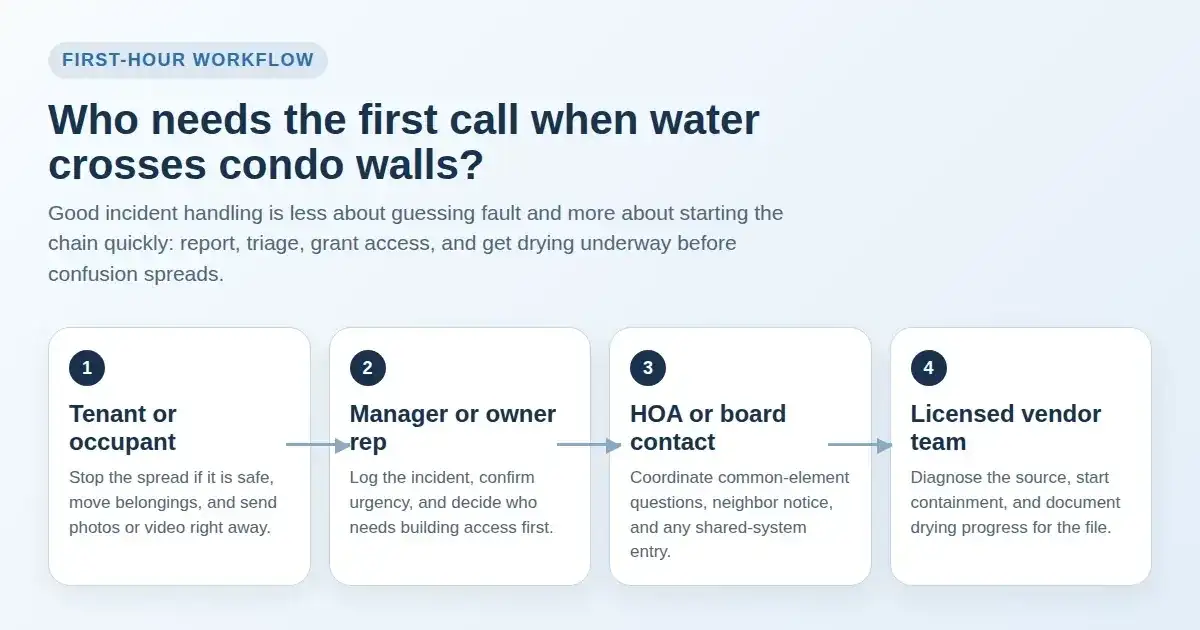
Why a stacked-condo leak becomes a coordination problem fast
Condo water damage landlord HOA questions usually arrive all at once in a stacked building. In a single-family rental, a leak may stay inside one address long enough for the owner and vendor to work it out quietly. In a stacked condo building, the same issue can involve a tenant, an owner, a board or HOA contact, a management company, neighboring units, a common pipe chase, and at least one vendor before the source is even confirmed.
That is why the first day is usually not won by whoever argues responsibility first. It is won by whoever creates a cleaner operating chain. Incubate PM's maintenance coordination page describes the right mindset well: collect photos, triage the urgency, dispatch the appropriate professional, and keep the work visible through one organized workflow instead of scattered texts and callbacks. Its condo association management page adds the building-level reality: condo boards are balancing complex systems, vendor oversight, resident communication, and large-scale repair projects at the same time.
That building context matters because a leak in a vertical community rarely stays a simple "call the plumber" event. A stain on one ceiling can turn into an access issue for the unit above, a common-element question for the association, a drying problem for soft materials, and a records problem for everyone involved. This guide keeps the focus on workflow, documentation, and escalation. It is general educational information, not legal, insurance, or engineering advice for any specific building.
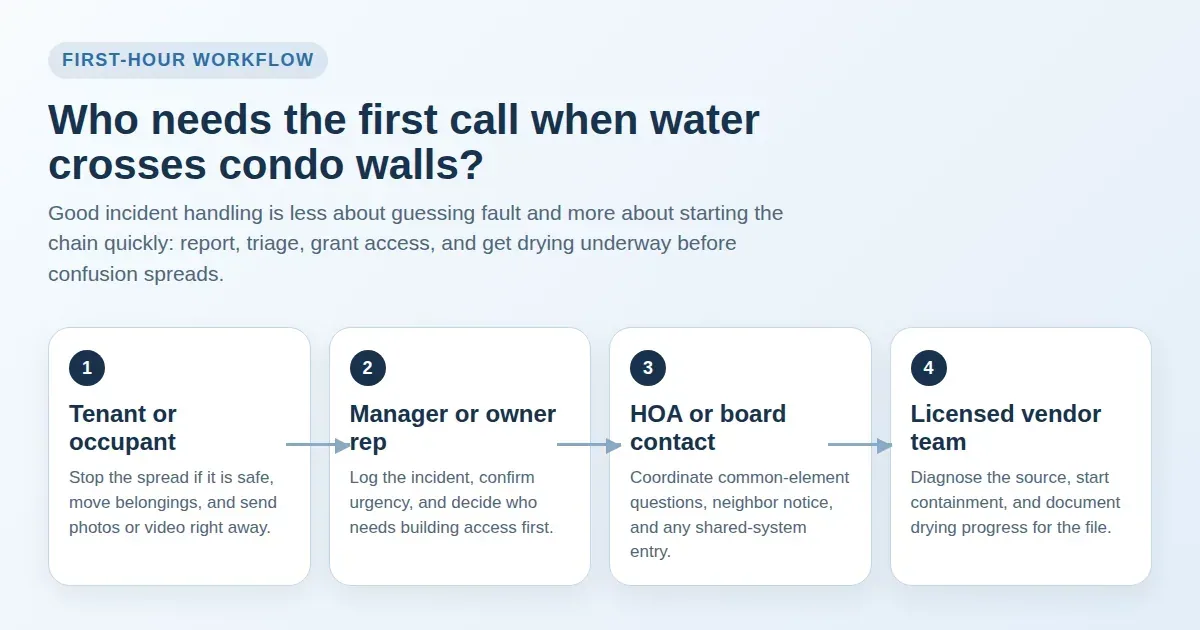 In a stacked condo, the fastest first call is the one that starts the whole chain: report, triage, access, and qualified vendor response.
First-hour steps: safety, shutoff, and photos
The first hour should stay boring on purpose. You are not trying to settle coverage, decode the declaration, or guess fault from the ceiling stain pattern. You are trying to make the scene safer and easier to understand.
Start with personal safety. Ready.gov's hurricane guidance says not to touch electrical equipment if it is wet or if you are standing in water, and to turn off electricity at the main breaker only if it is safe to do so. If water is near outlets, fixtures, or exposed wiring, the safest next move is often to back away, warn others, and let the appropriate building contact or licensed professional handle the next step.
After that, focus on containment that does not make the evidence worse. If the source is obvious and safe to reach, shutting off a nearby fixture valve may help. If not, do not lose time pretending certainty. Catch active drips, move electronics and soft goods out of the path, and protect flooring or furniture as best you can without erasing what happened.
Then document before cleanup changes the story. Ready.gov's recovery guidance says to take photos and make a list before cleanup begins, then save receipts for repair and cleanup costs. That is a practical standard for condo incidents too. A useful first photo set usually includes:
- one wide shot of each affected room
- one close shot of the suspected source area
- one shot showing how far the water has migrated
- one short note with the discovery time, who noticed it, and what changed next
Fast reporting matters for moisture control too. The EPA's guide to mold, moisture, and your home says the key to mold control is moisture control, and that water-damaged materials should be dried within 24 to 48 hours in most cases to help prevent mold growth. The same guide tells renters to report plumbing leaks and moisture problems immediately to the building owner, manager, or superintendent. In plain language: do not wait to see if the spot dries on its own.
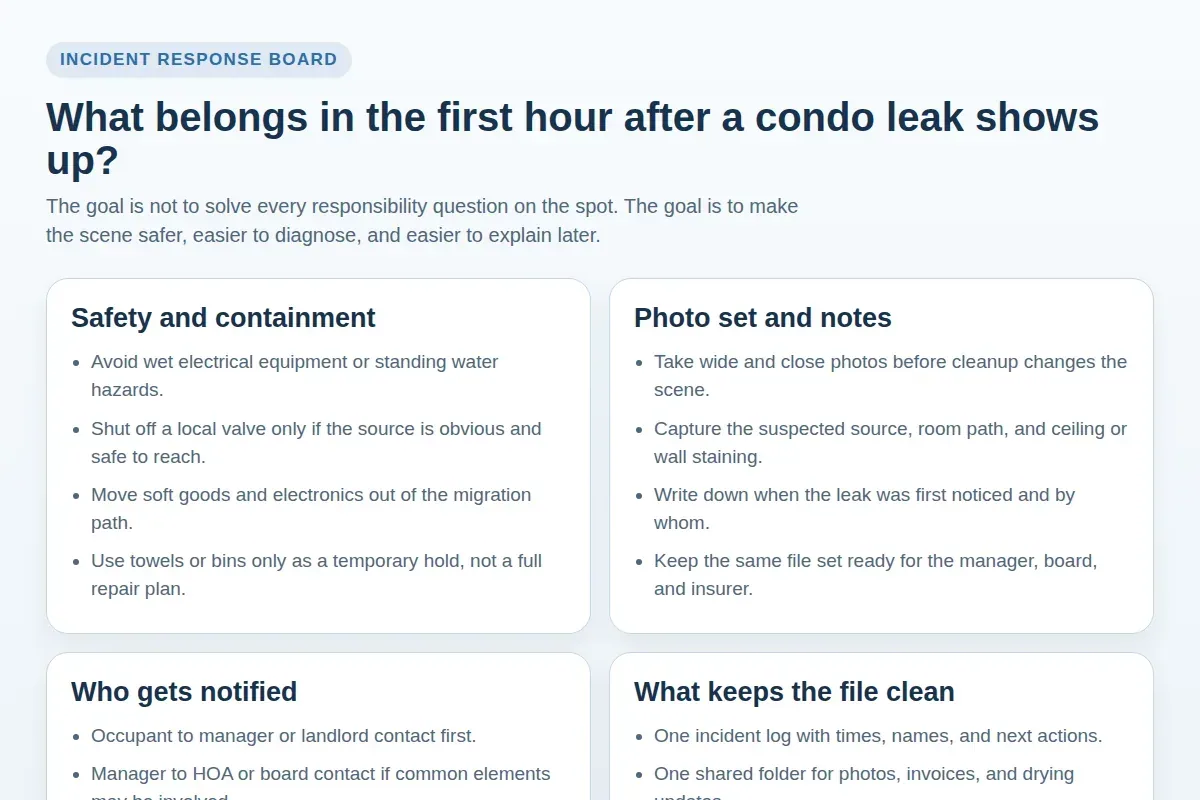 The first hour does not need a perfect diagnosis. It needs safer conditions, a usable photo set, and one clear communication chain.
A practical first-hour sequence usually looks like this:
- Check immediate safety. Look for electrical risk, slipping hazards, or active spread into hallways or lower units.
- Limit obvious damage if safe. Catch drips, move belongings, and use a local shutoff only when the source is clear and reachable.
- Send the first report. Occupants should notify the owner, property manager, or emergency maintenance contact with photos and a short description.
- Start the incident log. Record discovery time, who was called, what was observed, and what was promised next.
What the tenant, landlord, HOA, and property manager each do next
The most common delay in a stacked-condo leak is role drift. Everybody assumes someone else is handling the next call, the next approval, or the next update. A stronger response starts by separating the jobs.
Tenant or occupant: The occupant is usually the first person with eyes on the problem. Their job is not to assign blame. Their job is to report quickly, provide photos or video, protect personal belongings where possible, and keep the manager or owner updated if the water spread changes.
Landlord or unit owner: The owner usually needs to confirm who is leading the response, approve owner-side vendor work when necessary, keep insurance or stakeholder contacts informed, and make sure the unit can actually be accessed. In condo buildings, owners also need to respect that some parts of the response may involve association processes, neighboring units, or building systems outside a single lease relationship.
HOA or condo board contact: The association side matters when the issue may involve common elements, shared systems, or neighboring units. HOA vs condo management in Florida is a useful companion read here because condo operations often require communication density that single-unit ownership does not. Elevators, risers, mechanical rooms, shared shutoffs, and resident access windows can all matter before the repair scope is final.
Property manager: A manager should be the traffic controller. Incubate's maintenance page says tenants can submit requests through an online portal with photos, that the team triages the urgency, dispatches vetted vendors, and keeps the work visible through the owner portal. In a stacked-condo incident, that kind of centralized workflow is often the difference between one clean file and four people reconstructing the story later from text messages.
Florida law also explains why access questions cannot always wait. Florida Statutes section 718.111 says a condominium association has the irrevocable right of access to each unit during reasonable hours when necessary for maintenance, repair, or replacement of common elements, or as necessary to prevent damage to the common elements or to a unit. That does not answer every building-specific responsibility question by itself, and governing documents still matter. It does explain why association involvement can become urgent when a leak threatens other units or shared systems.
A simple way to keep roles clean is to ask four questions out loud:
- Who owns the next call?
- Who can authorize access?
- Who is dispatching the vendor?
- Who is updating the single incident log?
If those answers are fuzzy, the building is already losing time.
How access, vendors, and drying decisions change the outcome
Many condo water events get more expensive not because the original source was dramatic, but because the handoff between diagnosis and dry-down was sloppy. The source may be a unit issue, a shared line, a roof path, or a system serving multiple areas. Until the access path is clear, the right vendor may not even be able to see the actual failure.
That is why vendor sequencing matters. Incubate's condo-management page highlights vendor and contractor oversight, building operations support, and official record maintenance. Its maintenance page adds the field workflow: triage, dispatch, completion, and transparent billing using vetted, licensed, and insured contractors. In practice, that means the manager or association contact should be reducing friction for the vendor, not adding to it. Good prep includes service elevator instructions, parking details, neighbor access notes, gate codes where allowed, and a clear description of which unit first noticed the problem.
Drying decisions matter just as much as plumbing decisions. EPA says water-damaged materials and areas should be dried within 24 to 48 hours in most cases to help prevent mold growth. It also says absorbent or porous materials may need to be discarded if they become moldy, and that the water problem itself has to be fixed or the mold problem will come back. In other words, do not wait for everyone to agree on final fault before the building starts acting like moisture is a live problem.
That is especially true in South Florida. Incubate's maintenance page calls out humidity and moisture control as a core part of protecting finishes and HVAC systems, and it specifically flags clogged AC drain lines as a recurring cause of interior water damage. Whether the first sign is a dripping return vent, a ceiling stain below another unit, or water around a shared wall, the operating lesson is the same: diagnosis and dry-down have to move in parallel.
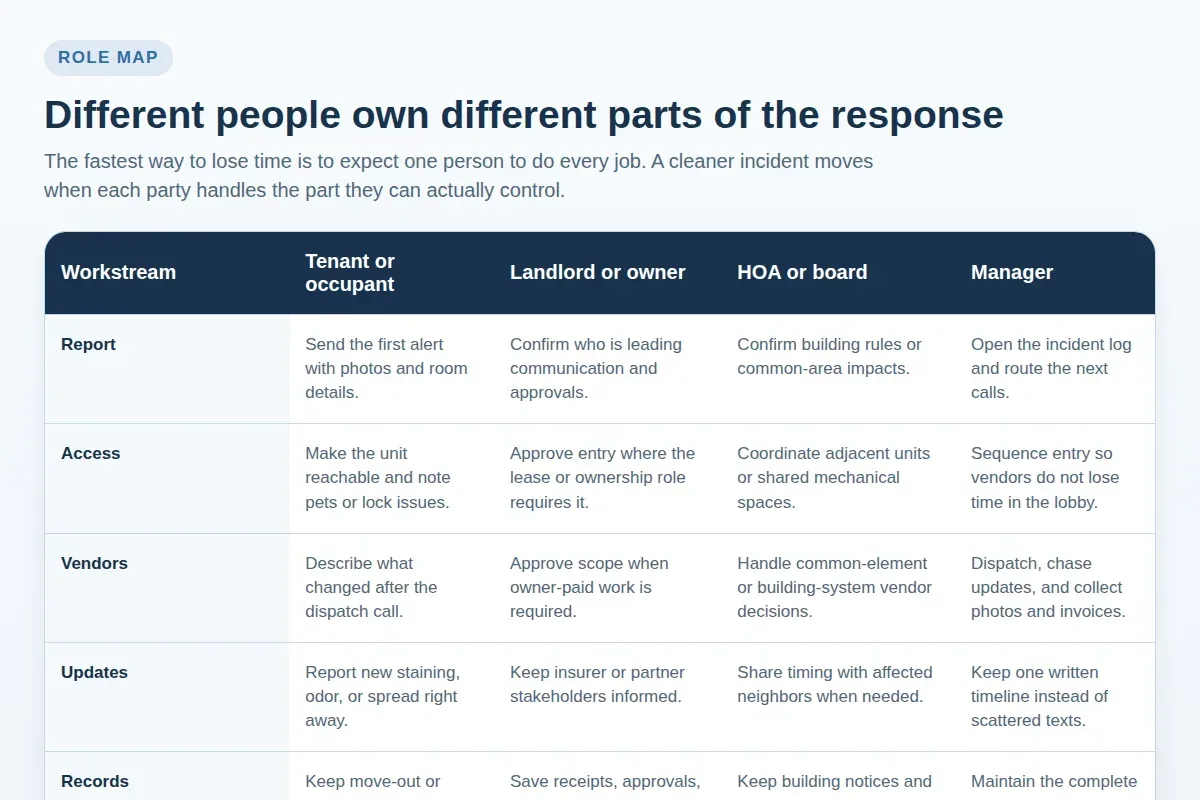 Role clarity keeps a condo leak from becoming four separate conversations about the same problem.
A manager earns value here by making the next step smaller for everyone else:
- the occupant knows where to send updates
- the owner knows who is coordinating access
- the board knows whether common elements or neighboring units may be implicated
- the vendor knows how to enter, document, and report back
That does not make the event easy. It makes it organized enough to resolve.
Which records, receipts, and updates belong in the incident file
A clean incident file is one of the most underrated parts of the whole response. People remember to take one or two urgent photos. They forget how quickly details get lost once the first vendor leaves, another unit reports staining, or someone asks what happened yesterday at 3:15 p.m.
Ready.gov's recovery guidance offers the right backbone: document damage before cleanup, make a list, and save receipts. For condo water damage, that usually expands into one working file with:
- the first report from the occupant or neighbor
- wide and close photos before cleanup changes the scene
- a time-stamped call and update log
- access notes for the affected unit, adjacent units, or common spaces
- vendor proposals, moisture readings, invoices, and completion photos
- emails or written updates sent to the owner, board, or residents
- receipts for emergency supplies, cleanup, and temporary protection steps
The purpose of this file is not only insurance. It is operational memory. When the source turns out to be different than expected, when the board asks for a summary, or when the owner wants to know why a second vendor was dispatched, the file should already answer most of the questions.
A stronger update habit helps too. After every meaningful change, send one short written summary: what was found, what was done, what still needs access or approval, and what happens next. That discipline prevents three common failures:
- The repeated question loop - different people keep asking for the same facts because nobody sent a clean summary.
- The missing receipt problem - the cost trail becomes harder to reconstruct after emergency work is already underway.
- The false-finish problem - the visible leak slows down, but nobody confirms whether the water source, wet materials, or drying equipment plan were fully addressed.
Incubate's rental property owners hub is useful here because it frames ownership around coordinated operations rather than one-off repairs. That is the right lens for a condo leak too. The owner does not only need a plumber. The owner needs a documented process that can survive board questions, neighbor involvement, and follow-up work.
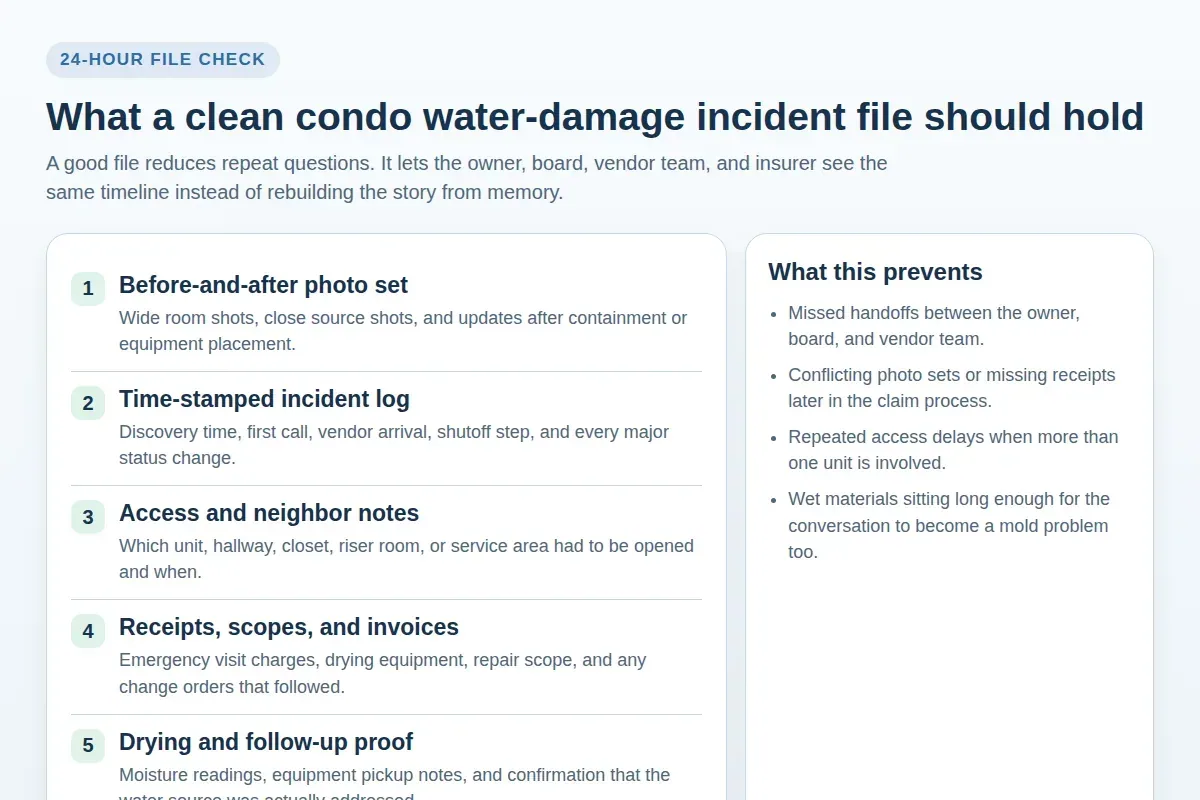 The cleaner the incident file, the less likely the owner, board, or vendor team will have to rebuild the story from memory later.
A practical 24-hour checklist for the next board or owner call
If you want a simple operating standard for the first day, use this checklist:
- Protect people first. Stop anyone from touching wet electrical equipment or entering unsafe areas.
- Collect the first image set. Get wide shots, close shots, and a short written summary before cleanup changes the scene.
- Start one communication chain. Make sure the occupant, owner, manager, and association contact all know who is steering updates.
- Clarify access immediately. If the source may involve another unit, a chase, or a common system, get the building-side access conversation moving early.
- Dispatch the right vendor, not just the fastest guess. A cleaner diagnosis saves time later.
- Treat drying like an active deadline. EPA's 24-to-48-hour moisture window is a practical reason to move fast, not a detail for later.
- Keep one incident file. Photos, receipts, notes, scopes, and updates should live together.
- Escalate when the issue crosses workflows. If the event now touches the board, neighboring units, or a larger building-system problem, move it into a managed process instead of ad hoc texting.
If your building keeps repeating the same leak-response mistakes, start with Incubate PM's maintenance coordination and condo association management pages, then use the contact page to discuss how your current intake, vendor, and documentation workflow is actually operating day to day.
Condo declarations, leases, insurance policies, and building conditions vary, so confirm fault, coverage, and legal obligations with the appropriate association counsel, insurer, engineer, or licensed trade professional before acting on any one article.