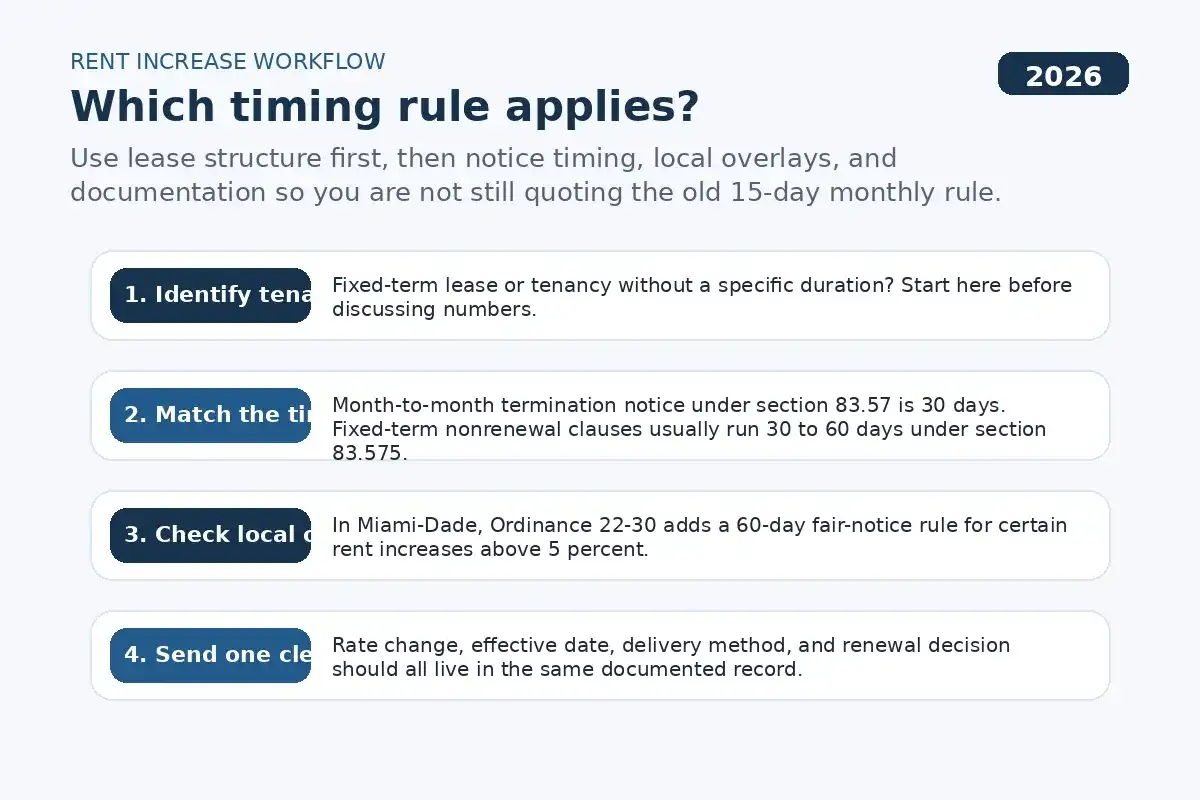
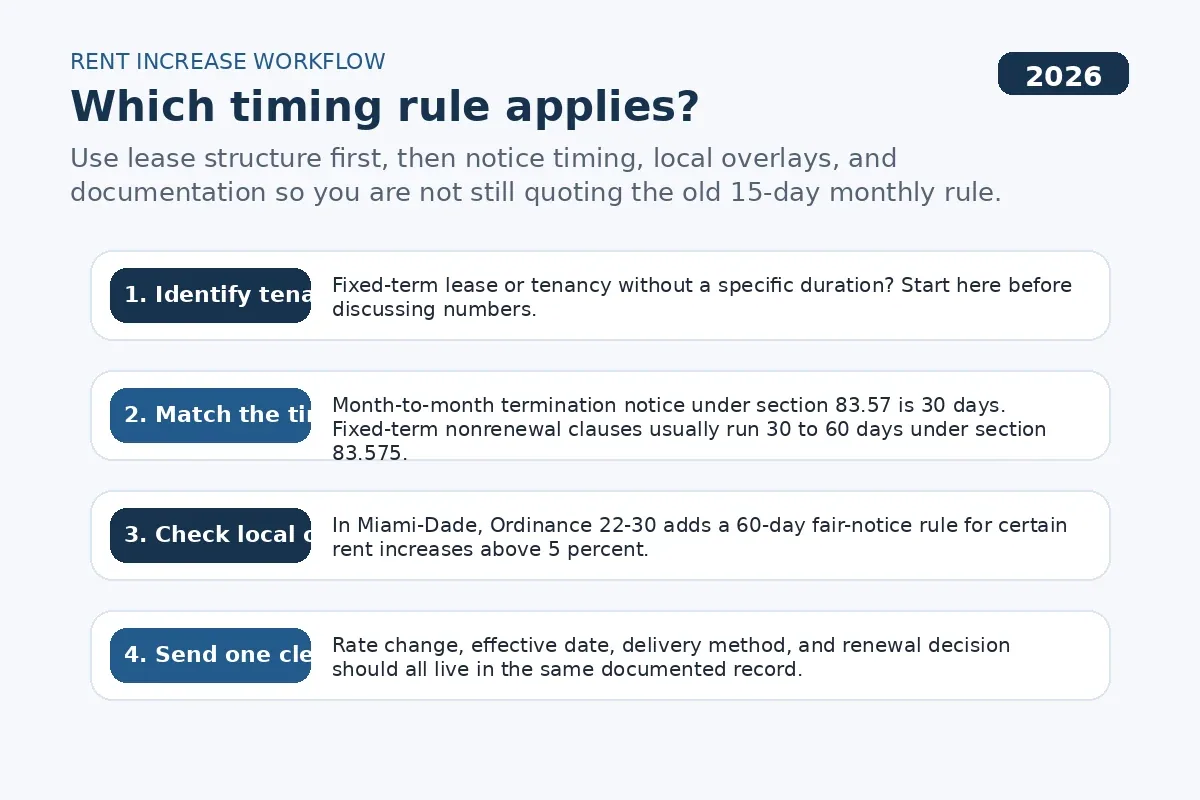
 The most common rent-increase mistake is not the percentage. It is applying the wrong timing rule to the wrong tenancy and only discovering the problem after the notice is already out.
A good Florida rent increase strategy 2026 starts after you understand the legal backdrop, not with it. If you need the statewide notice rules first, start with Incubate PM's Florida rent increase laws guide. This article picks up where that guide stops: renewal workflow, local checks, comps, and retention-versus-vacancy math.
That distinction matters because Florida owners rarely lose money by forgetting there is no statewide rent cap. They lose money by applying the wrong timing rule to the wrong tenancy, skipping a local fair-notice check, or chasing a headline increase that turns into vacancy, make-ready work, and a rushed re-lease. The current text of Florida Statute 83.57 now requires 30 days' written notice before the end of a monthly period for a month-to-month tenancy without a specific term. For leases with a specific duration, Florida Statute 83.575 points you back to the lease's renewal language while limiting certain nonrenewal notice provisions to a 30-to-60-day window.
This guide is written for landlords and rental owners who want the legal timing and the operating decision to line up. It stays grounded in how Incubate PM talks about the back half of ownership: rent collection, owner visibility, screening, leasing, and the cost of avoidable turnover. It is general educational information only, not legal advice for a specific lease or property.
Why the legal backdrop is only the starting point
The confusing part of this topic is that there is no single Florida statute titled "rent increase notice." Landlords usually have to work from the tenancy structure, the lease terms, and any local overlay that applies where the property sits.
That is where outdated summaries create trouble. The old month-to-month number still shows up around the web, but the current statute is not ambiguous on that point. Section 83.57 says a month-to-month tenancy without a specific duration may be terminated by giving not less than 30 days' written notice before the end of the monthly period. If your process still assumes 15 days, the workflow is already behind the law.
The other common mistake is stopping at the legal minimum. A notice may be technically timely and still be a poor operating decision if the new rate ignores local competition, resident history, or the full cost of a new lease-up. The law tells you the floor. It does not tell you whether the increase is smart.
What current Florida statutes say about month-to-month and fixed-term timing
The cleanest way to read this topic is to separate three questions.
First, what kind of tenancy do you have? Florida Statute 83.46 says that when a rental agreement contains no provision as to duration, the tenancy is determined by the period for which rent is payable. If rent is payable monthly, the tenancy is from month to month. That section is the starting point because it tells you whether you are even in the periodic-tenancy framework.
Second, what notice timing applies when there is no specific duration? Section 83.57 lays that out clearly:
| Tenancy type without a specific duration | Current Florida notice in section 83.57 |
|---|---|
| Week to week | 7 days before the end of the weekly period |
| Month to month | 30 days before the end of the monthly period |
| Quarter to quarter | 30 days before the end of the quarterly period |
| Year to year | 60 days before the end of the annual period |
Third, what if the lease has a specific duration? Section 83.575 says a rental agreement may contain a provision requiring notice before vacating at the end of the term if it also requires the landlord to notify the tenant within that notice period if the agreement will not be renewed. The statute also says the agreement may not require less than 30 days' notice or more than 60 days' notice from either side. In practice, that means the lease language matters, and a fixed-term renewal should be handled as a lease-end decision rather than as a surprise midstream rate change.
A lawful increase is also not a blank check on motive. Florida Statute 83.64 says it is unlawful for a landlord to discriminatorily increase rent or decrease services primarily in retaliation for a tenant exercising protected rights in good faith. That is a useful reminder for owners who think this topic is only about calendars. Timing matters, but so do consistency and reason.
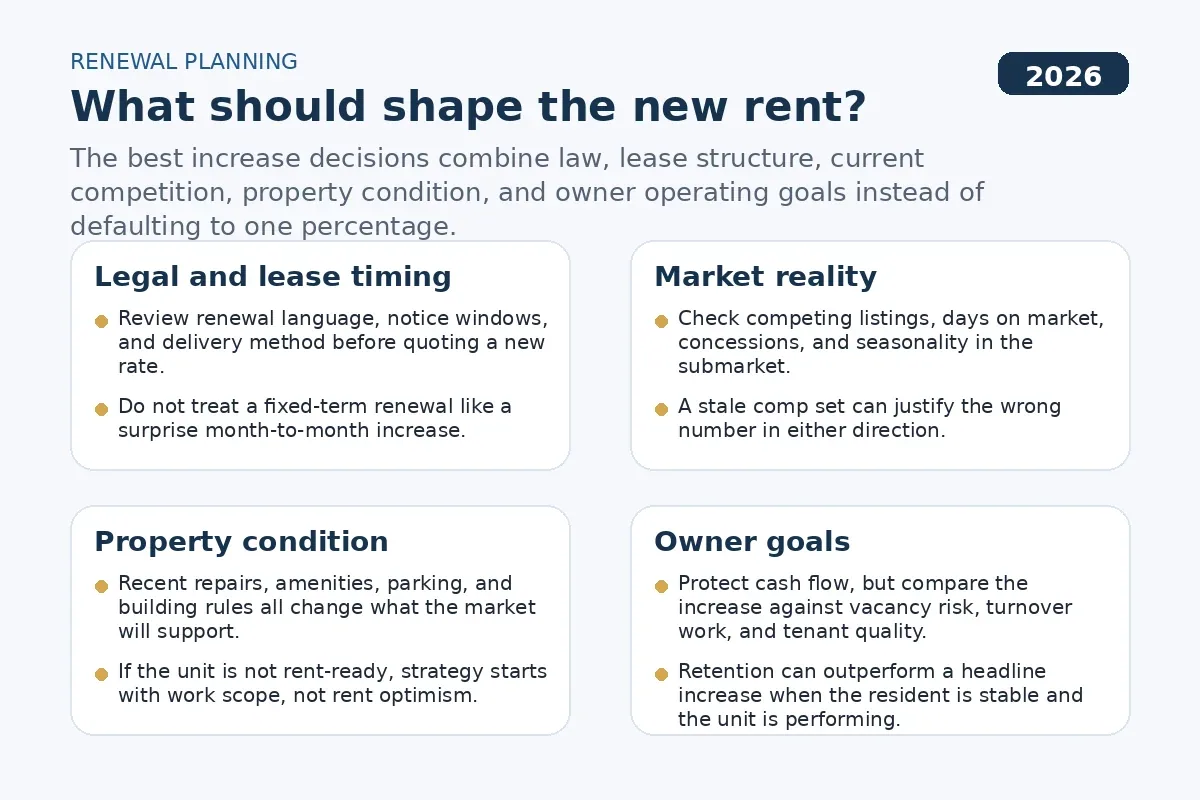 Good rent decisions start with the law, but they only become good business decisions after you pressure-test the market, the unit, and the owner’s actual goals.
How to build a rent increase workflow before renewal season
A better process starts earlier than most owners expect. Do not wait until the lease is almost over and then scramble backward into the notice window.
Start by confirming the tenancy type and the lease clause that governs the end of the term. Then gather the operating inputs that explain whether a change is warranted at all: current rent, recent payment behavior, repair history, upcoming expenses, competing listings, and whether the property needs work before a new rate will be defensible.
Incubate PM's owners page frames this in a way that is more useful than generic landlord advice. It says owners should be able to see real-time rental payments and balances, review and approve maintenance work orders, and download monthly statements and tax documents from the portal. That kind of visibility matters because a renewal decision is stronger when it comes from records instead of instinct. If the resident pays consistently, the ledger is clean, and the unit is stable, your decision tree looks different than it does for a chronically late payer in a unit that needs re-positioning.
The next step is documentation. Keep the comp set, the lease clause, the proposed effective date, and the delivery method in one file. If the tenant negotiates, renews, or declines, the conversation stays tied to the same record. Owners get into preventable messes when the legal timing lives in one email, the market logic lives in another spreadsheet, and the actual notice goes out without either document close at hand.
When market reality should change the number, not just the notice
The most expensive rent decision is often the one that feels emotionally satisfying for one month and strategically weak for the next three.
That is why the new number should come from the market and the unit, not only from the owner's frustration with rising costs. Insurance, taxes, association fees, maintenance, and management costs can all move. But the question is still whether the property can support the increase in its present condition against current competition.
Incubate's rental property owners page is useful here because it does not frame ownership as passive by default. It calls out late rent, maintenance emergencies, legal complexity, vendor coordination, and vacancy drag as the real workload around the asset. That is a better lens for pricing than a simple rule like "raise it every year." A unit with dated finishes, slower leasing demand, or building friction may justify a smaller increase than the owner hoped. A well-positioned unit with stronger market support may justify more.
The leasing and tenant placement page adds another important detail: vacancy is not just lost rent. Re-listing means photography, showings, screening, lease preparation, move-in coordination, and usually at least some repair or cleaning work. If a higher rate is going to push the resident out, compare the upside to the full cost of replacing them.
Why retention and vacancy math matter more than one big hike
Owners usually compare a new rent amount to the old one. A better comparison is the annual cash flow of the likely outcomes.
If a reliable resident renews at a moderate increase, you may preserve occupancy, avoid fresh leasing costs, and keep the unit producing without interruption. If the resident leaves after an aggressive increase, you may spend the next several weeks paying for vacancy, make-ready work, showings, screening, and time. In some situations the larger increase still makes sense. In others it looks strong only because the turnover cost has been ignored.
Incubate's rent-collection pages consistently push the value of clean ledgers, automated reminders, faster disbursements, and transparent owner reporting. That operating posture fits this decision well. A resident with a strong payment track record and low management friction is not the same as a resident who turns every month into a collection problem. Retention is more valuable when the tenant relationship is healthy and the property is performing.
Use a simple three-way comparison before you send the notice:
- what happens if rent stays flat for another term
- what happens if you pursue a moderate increase with higher renewal odds
- what happens if you pursue the largest number the market might tolerate and then absorb the turnover risk if the resident leaves
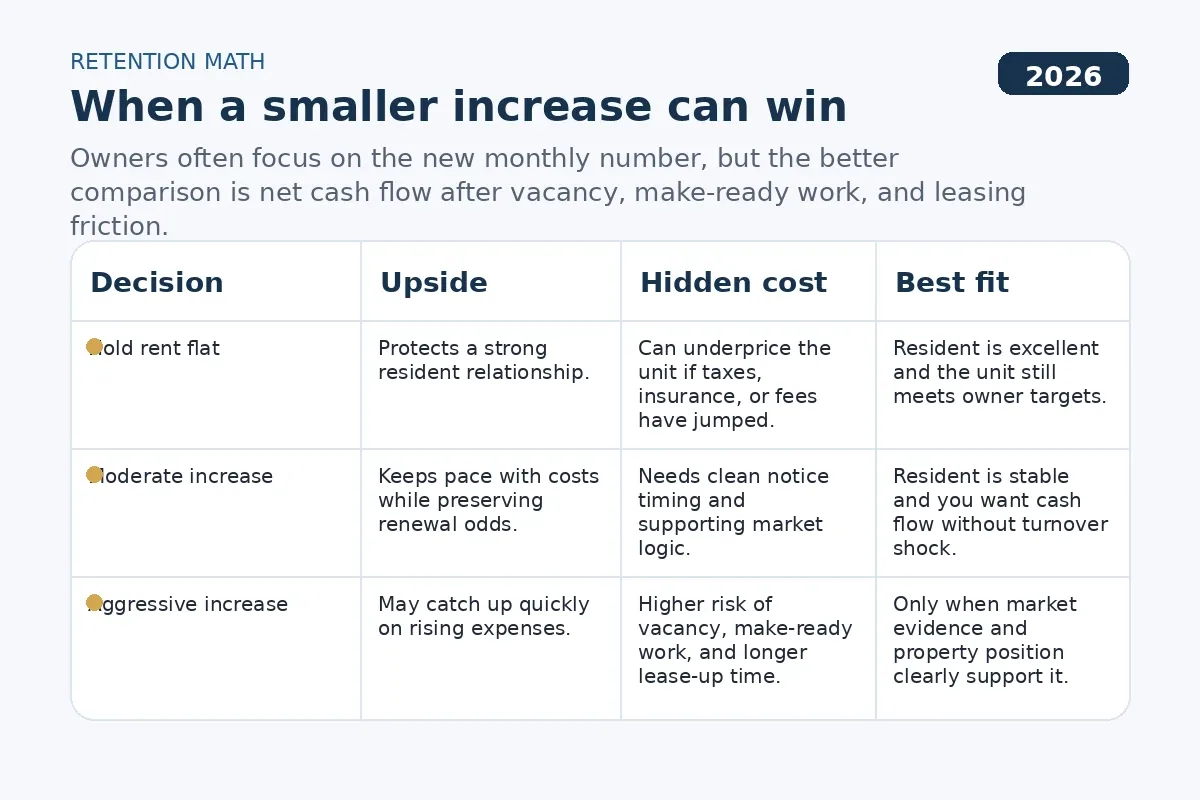 The smarter comparison is not old rent versus new rent. It is steady cash flow versus vacancy friction versus the total cost of getting a new resident in place.
That is not legal advice. It is just cleaner math. And cleaner math usually leads to calmer decisions.
Where Miami-Dade owners need an extra local check
South Florida owners have one more reason to slow down before they send notice: local rules can add a stricter layer than the statewide baseline.
Miami-Dade County's adopted Ordinance 22-30 says a residential landlord who proposes to increase the rental rate by more than 5 percent at the end of a lease for a specific term, or during a monthly tenancy without a specific duration, must provide a minimum of 60 days' written fair notice before the tenant must accept, negotiate, or reject the proposed amendment. The same legislative matter also enlarged the county's monthly termination notice period for certain residential tenancies.
That does not mean every Florida property follows Miami-Dade's local rule. It does mean Miami-Dade owners should not stop their analysis at the statewide 30-day monthly rule. Verify the current local rule that applies to your property's jurisdiction and facts before you send notice.
How Incubate frames rent collection and owner visibility
One thing Incubate does well across its owner-facing pages is connect pricing decisions to operating systems rather than treating them as isolated legal events.
On the rent-collection page, Incubate says tenants can pay through an online portal, automated reminders go out before rent is due, and every payment is recorded in the property's ledger. The same page says owners can track when rent is paid and when it is disbursed. On the owners page, Incubate adds statement downloads, work-order approvals, and inspection-photo visibility. On the rental-owner page, it frames the overall service around reducing late-payment stress, handling maintenance coordination, and giving owners institutional-grade reporting.
That combination matters because a rent increase is easier to defend and easier to evaluate when the underlying records are already organized. You want to know whether the resident pays reliably, whether maintenance costs are drifting upward, whether the unit is due for repositioning, and whether the property can support a renewal at the target rate. Those are operating questions before they are negotiation questions.
If you are comparing management options, this is one of the better claims to pressure-test. Ask what the renewal workflow actually looks like in practice. Where do the ledger, the notice file, the maintenance history, and the leasing backup live? A cleaner answer there is often more valuable than a broad promise about "maximizing rent."
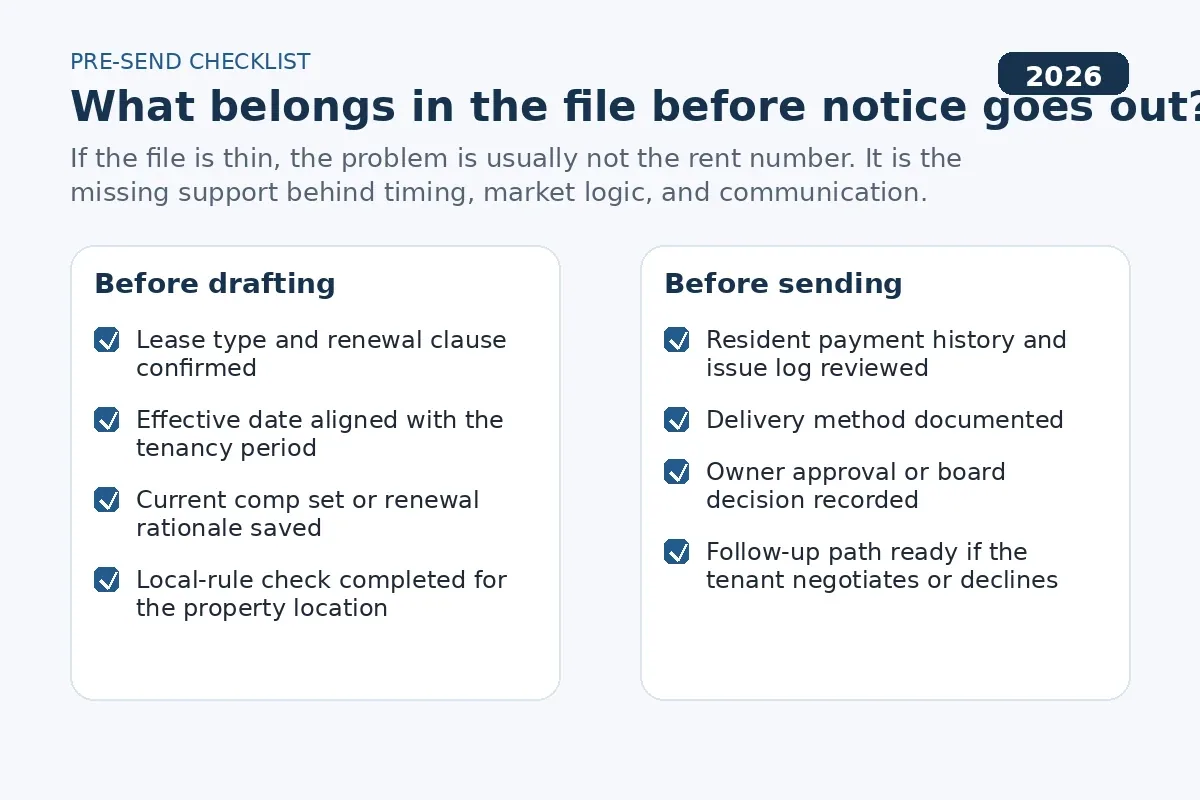 Notice timing matters, but so does the file behind the notice: lease language, market comps, resident history, owner approval, and a clear next step if the tenant wants to negotiate.
A pre-send checklist before you raise the rent
Before you send any rent increase notice, make sure you can answer yes to these questions:
- Do I know whether this is a fixed-term renewal or a tenancy without a specific duration?
- Have I checked the current Florida timing rule that matches that tenancy structure?
- Have I reviewed the lease for any renewal or nonrenewal clause that changes the workflow?
- Have I checked whether a local notice rule applies where the property is located?
- Do I have current market support for the new rate, not just frustration with rising expenses?
- Have I weighed the increase against vacancy, make-ready work, and leasing friction if the resident leaves?
- Is the resident file clean enough that I can explain the decision calmly if the tenant pushes back?
- Is the delivery method and effective date documented in one place?
That checklist will not remove every difficult conversation. It does remove the most avoidable mistakes.
If you want the legal backdrop first, start with the laws guide and resource page linked above. If you want help pressure-testing renewal timing, reporting, and turnover risk for a South Florida rental, use the contact page.
This article is general educational information only. Lease wording, municipal rules, fair-housing obligations, and retaliatory-conduct questions can change the right next step for a specific property. Confirm important decisions with the relevant official sources and qualified professionals before acting.