Florida Lease Renewal Decision Guide: When Owners Should Renew, Reprice, or Re-List
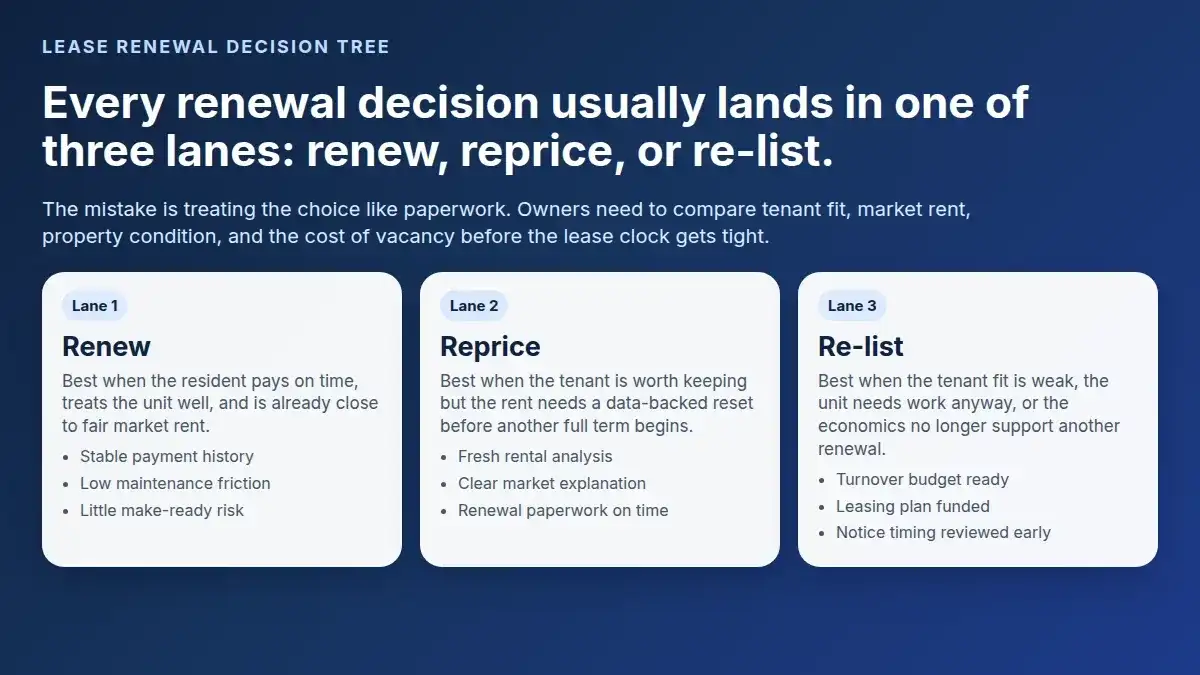
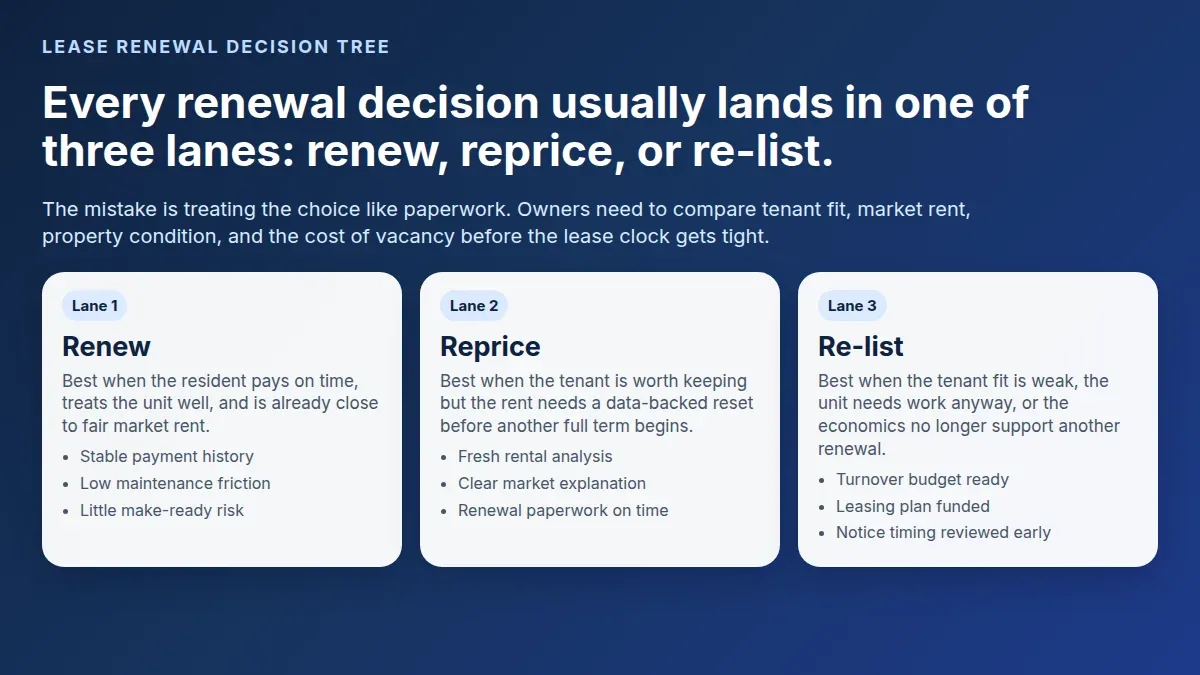 A useful lease-renewal call is not just about paperwork. It is a choice between three lanes: renew the resident, reprice the next term, or prepare the unit for a new listing.
A Florida lease renewal checklist for landlords should answer a much harder question than "Did we send the renewal?" It should help you decide whether keeping the current resident still beats the cost of a turnover, whether the rent needs a data-backed reset, and whether the property condition or lease timing makes a re-list more sensible than another full term.
If you need the legal notice explainer first, start with Incubate's live Florida rent increase laws page. If you already know the resident is leaving and need the execution companion, use the live rent-ready turnover checklist. This page sits one step earlier: decide whether to renew, reprice, or re-list at all.
That is where many owners lose money. They wait too long, treat the decision like an admin task, and then discover they are making a pricing call, a maintenance call, and a vacancy-risk call all at once. Incubate PM's live owner pages already describe the pain points clearly: late rent, maintenance emergencies, compliance pressure, and the time drain of marketing, showings, and screening. This article turns those moving parts into one decision framework before the lease clock gets tight. It is general educational information, not legal or accounting advice for your specific property.
Why lease-renewal decisions go wrong when owners wait too long
The biggest renewal mistake is not choosing the wrong rent number. It is choosing too late.
Once a lease is close to expiring, the owner is no longer deciding in a calm planning window. They are deciding under pressure, with less room to review payment history, less time to scope repairs, and less leverage to launch a clean marketing plan if the resident decides to leave.
Incubate's rental property owners page frames that problem well. The page points to the daily stressors that land on owners when operations are loose: chasing late rent, handling maintenance calls, keeping up with Florida rules, and spending too much time on marketing and screening. A renewal decision touches all of them at once. If the resident stays, the owner is locking in another term with the same payment habits and maintenance pattern. If the resident leaves, the owner is stepping into listing work, screening, lease drafting, and move-in documentation again.
That is why the wrong question is, "Should I send a renewal?" The better question is, "What outcome am I buying if I renew this tenant for another term?"
What to review 90 days before the lease ends
Owners usually need more than one document to make a smart call. A workable review starts about 90 days before the lease ends, even if the final paperwork happens later.
Here are the four most useful buckets to review first:
- Tenant performance: rent payment consistency, communication quality, lease compliance issues, and how the resident treats the property.
- Property condition: recurring work orders, unresolved maintenance items, and whether the unit needs upgrades before another full term makes sense.
- Market position: what comparable units are doing right now, not what you hoped the market would look like six months ago.
- Timing risk: when the lease ends, what notice windows apply, and how quickly you could market the unit if the resident leaves.
Incubate's rental analysis page is especially useful for the third bucket. It says a rental analysis is not only for vacancies; it is also meant for lease renewals to confirm whether the current resident is still paying a fair market rate when the lease expires. That matters because many owners anchor to the last lease number instead of the current market. A stale number can hurt you in both directions: too low and you leave money on the table; too high and you create avoidable vacancy if the resident declines.
Incubate's maintenance coordination page adds another detail owners often skip: South Florida maintenance is not neutral. Humidity, drain-line issues, and delayed small repairs can turn into larger problems fast. If the unit has unresolved maintenance friction, that should shape the renewal conversation early instead of becoming a rushed surprise after a move-out.
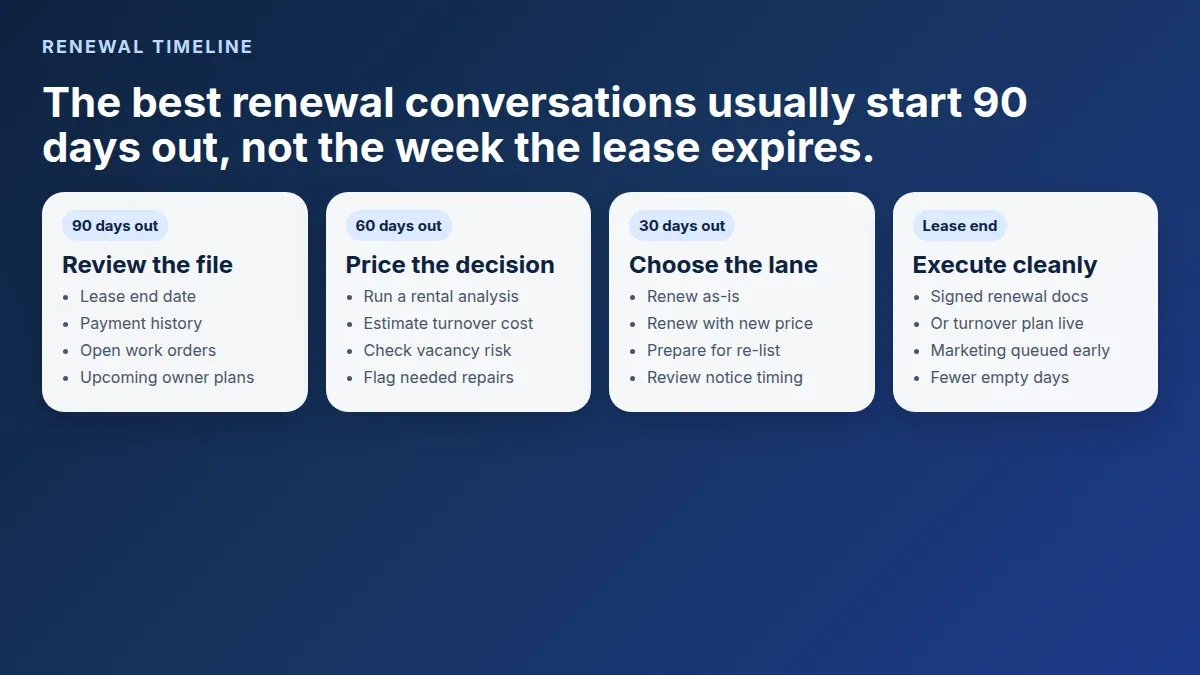 Owners usually get better outcomes when the decision starts 90 days out: review the file, run a fresh price check, choose the lane, then execute cleanly before lease end.
When turnover cost should change the renewal conversation
A resident leaving does not create only one expense. It creates a sequence.
If you are comparing a renewal against a re-list, the decision should include at least these turnover-side costs:
- vacancy days
- cleaning and make-ready work
- new photos or listing refresh work
- screening and lease-prep workload
- owner approval delays
- contingency room for South Florida maintenance surprises
Incubate's rental-analysis page gives a simple example of why timing matters more than many owners expect. Its illustration compares a property priced at $3,000 that rents in 10 days and produces about $35,100 in annual income with a property priced at $3,100 that sits vacant for 45 days and produces about $32,550. The point is not that those numbers apply to your unit. The point is that holding out for more rent can still lose if the vacancy window grows faster than the rate improvement.
That is where a renewal decision and a rent decision stop being the same thing. Sometimes the right answer is not "take the highest possible asking rent." Sometimes it is "keep a strong resident at a fair market number because the replacement path is more expensive than it looks."
There is another specific cost detail many owners appreciate once someone says it out loud: professional renewal and re-list workflows have their own admin costs. Incubate's property-management page labels its South Florida ranges as illustrative, not a quote, and says lease renewal is usually $200 to $500 or a small percentage of one month's rent, while tenant placement is often one month's rent or an agreed placement fee. Even owners who self-manage should think in those buckets, because the work still exists whether they outsource it or perform it themselves.
How pricing, payment history, and property condition shape the call
Most renewal decisions turn on four levers at the same time:
- Market rent: what a fresh analysis says the unit can earn now
- Vacancy drag: how much upside disappears if the re-list takes longer than expected
- Turnover scope: how much labor and cost sit behind the next listing
- Tenant fit: whether the current resident is easy to keep and worth keeping
Incubate's leasing and tenant placement page makes the turnover side more tangible. The service includes professional photography, 3D tours, syndication across more than 50 rental sites, screening, lease drafting, and move-in documentation. That is a reminder that re-listing is not just posting a new ad. It is a full relaunch.
If the current resident has strong payment habits, respects the property, communicates well, and sits close to fair market rent, renewal often wins even when the owner thinks a higher rent might be available elsewhere.
If the resident is inconsistent, creates avoidable wear, or repeatedly turns small maintenance items into larger ones, the next term may create more friction than it is worth. Incubate's maintenance page says residents are more likely to renew when the home is well-maintained and requests are handled quickly. The flip side is also useful: if the working relationship is already strained, another term can lock the owner into more conflict and more operating drag.
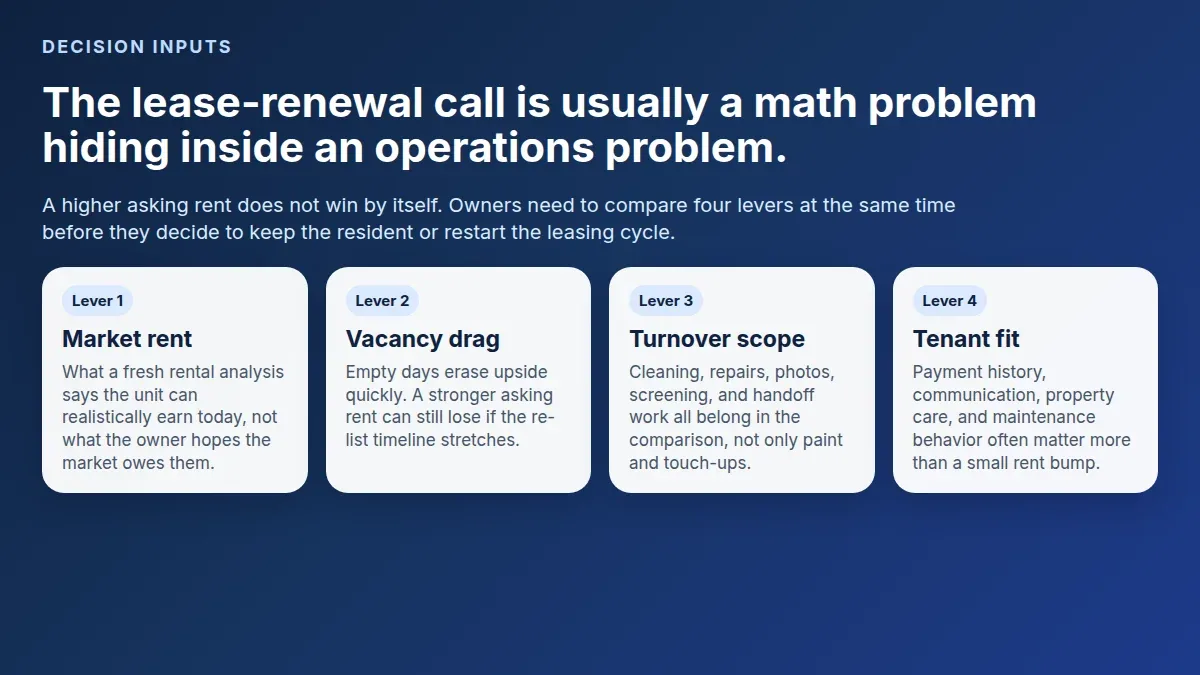 A higher rent target does not win by itself. The real comparison is between four levers: market rent, vacancy drag, turnover scope, and tenant fit.
The cleanest middle path is often reprice, but keep the resident. That lane works well when:
- the resident is desirable to keep
- the current rate is below what the market reasonably supports
- the unit does not need major make-ready work
- the owner can communicate a fair, timely renewal offer without rushing the file
That is also where a rental analysis earns its keep. Incubate says it goes beyond simple estimate tools by using MLS comps, property condition, local trends, and value-engineering suggestions. That lets the owner decide whether the real opportunity is a better renewal rate, a small improvement before renewal, or a turnover that truly resets the unit's position.
Where Florida notice timing changes the workflow
Florida timing rules matter, but they should be used carefully and in context.
For month-to-month tenancies, Florida Statute 83.57 says either party may terminate with at least 30 days' written notice before the end of the monthly period. The same section also lists other notice periods for tenancies without a specific duration: 60 days for year-to-year, 30 days for quarter-to-quarter, and 7 days for week-to-week.
That does not mean every renewal in Florida runs on the same statutory clock. Many renewal terms, notice rules, and extension options are controlled by the signed lease itself. The practical takeaway is simple:
- review the lease language early
- confirm whether the tenancy is fixed-term or without a specific duration
- avoid assuming the same notice rule applies to every resident
- line up the renewal decision before the legal or contractual clock forces a rushed outcome
Incubate's leasing page says its process includes legally compliant Florida lease drafting and move-in documentation. That is useful because a clean renewal workflow depends on more than sending a number. It depends on whether the current file is organized, whether the owner has already chosen the lane, and whether the paperwork matches the timing that applies to that tenancy.
A renew, reprice, or re-list worksheet owners can adapt
When owners feel stuck, a worksheet is usually more useful than another abstract reminder to "plan ahead." Use a simple four-part worksheet like this before you choose a lane:
| Worksheet | What to write down | Why it matters |
|---|---|---|
| Current tenant | Payment trend, communication quality, lease issues, likelihood the resident wants to stay | A strong resident can be worth more than a small theoretical rent bump |
| Market position | Fresh rental range, competing listings, value-add ideas, likely renewal target | Keeps the decision tied to current conditions instead of stale assumptions |
| Turnover cost | Vacancy estimate, make-ready scope, relaunch tasks, contingency reserve | Shows whether the upside of a re-list survives the actual reset cost |
| Lease clock | Notice dates, owner approvals, paperwork steps, marketing backup plan | Prevents timing mistakes from deciding the outcome for you |
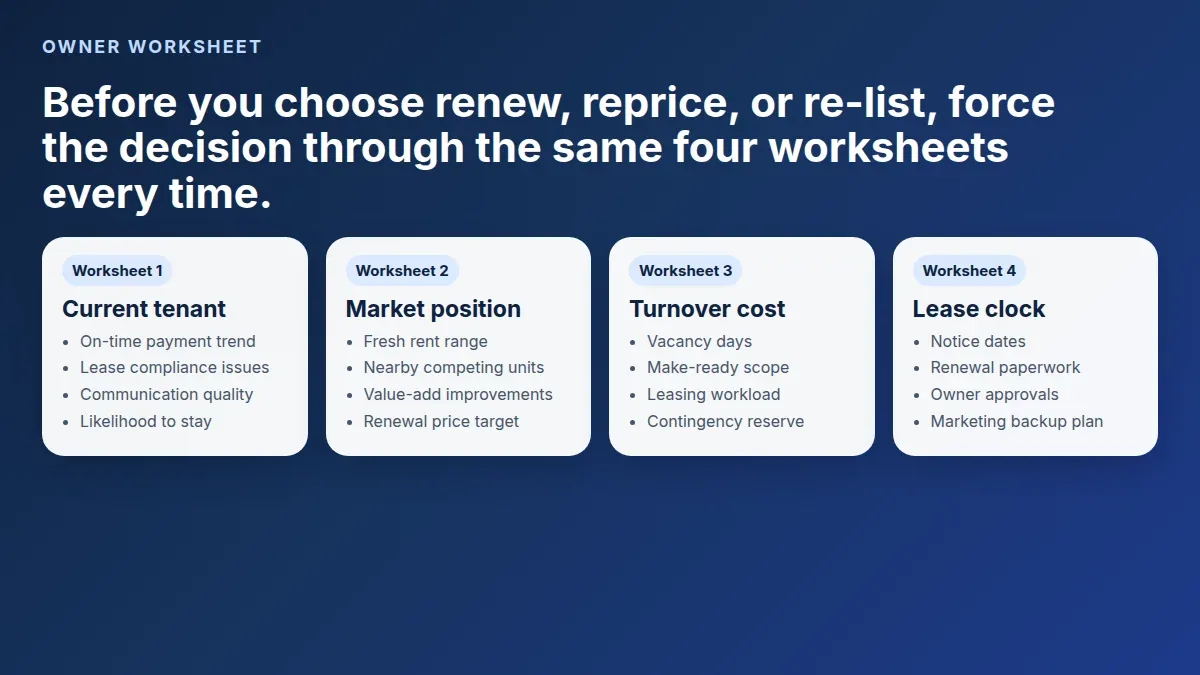 A repeatable worksheet keeps the decision honest. It forces the owner to compare resident quality, market rent, turnover cost, and timing instead of reacting to one number in isolation.
One more practical rule helps: if you are leaning toward a re-list, act like that choice is real now. That means estimating the turnover, planning the marketing handoff, and pricing the vacancy risk before the tenant gives final notice. If you are leaning toward a renewal, act like that choice is real too: run the analysis, choose the rent position, and move the paperwork before timing becomes the problem.
How Incubate's workflow helps owners decide earlier
Incubate's service stack is useful here because it shows how the decision becomes operational instead of emotional.
The owner pages emphasize the full lifecycle: marketing, screening, rent collection, maintenance coordination, and reporting. The rental-analysis page gives the price-and-vacancy lens. The leasing page makes the relaunch workload visible. The maintenance page adds the South Florida reality check around humidity, drain lines, and preventive care. Put together, those workflows help an owner answer the real renewal question sooner:
- Is this resident someone you want to keep?
- Is the rent still defensible in today's market?
- What would the turnover actually cost?
- Can the file be executed cleanly under the right timing?
If you want to pressure-test your own decision before the lease ends, start with Incubate's Florida rent increase strategy 2026 and compare that with the live leasing workflow, the rental-owner service stack, and the contact page if you want a local conversation about the next term for your property.
This article is general educational information only. Renewal timing, notice obligations, pricing strategy, and lease terms vary by property and situation, so confirm important decisions with the signed lease, qualified legal counsel when needed, and the relevant official Florida sources before acting.