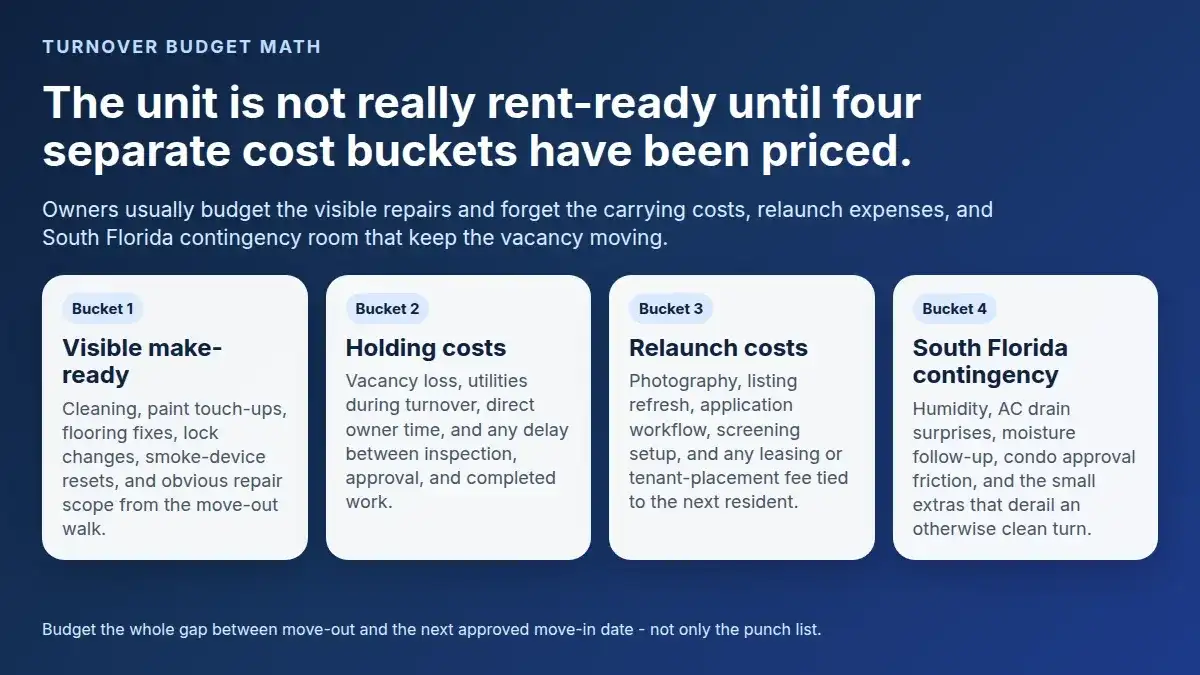
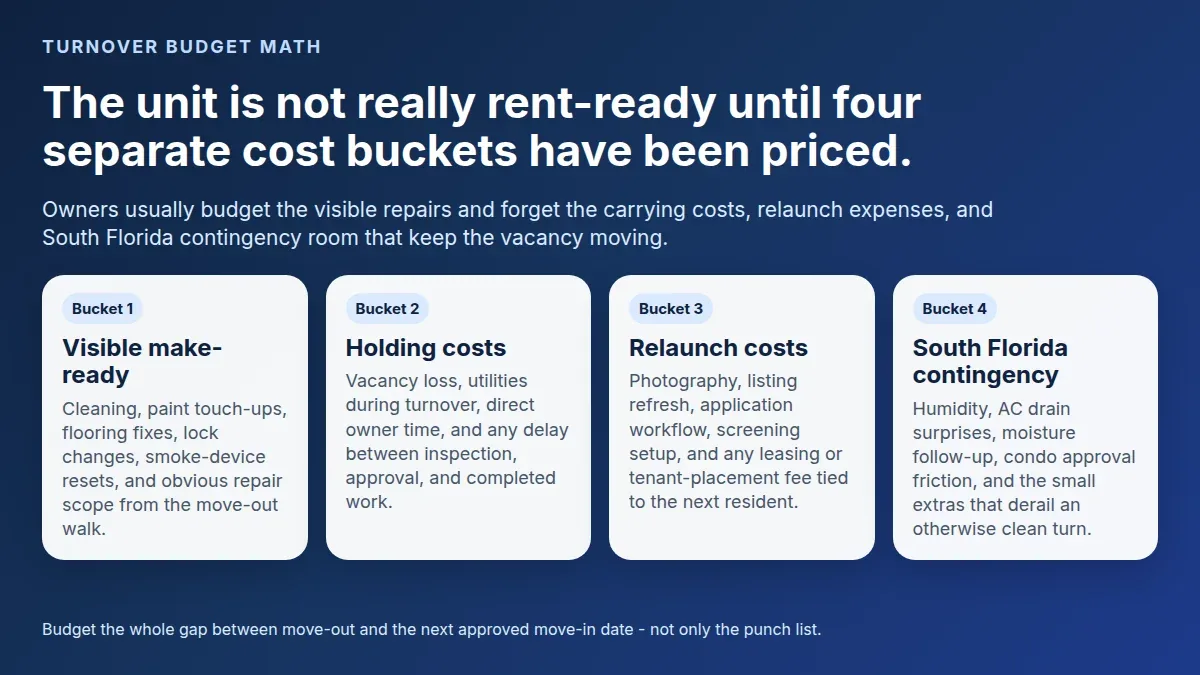
 A clean turnover budget does not stop at paint and cleaning. The real number has to cover the whole gap between move-out and the next approved move-in date.
A rental turnover budget usually goes wrong before the first vendor invoice arrives. The owner prices the visible fixes, assumes the unit will come back online quickly, and only later notices the other costs stacking up in the background: empty days, utilities during vacancy, listing relaunch work, owner approvals, condo logistics, and the South Florida maintenance surprises that appear after the cleaner leaves.
That is why this guide is narrower than Incubate PM's live turnover checklist. The checklist is about execution. This article is about pricing the turn before the schedule starts slipping. It uses Incubate's published owner, leasing, maintenance, rent-collection, and planning-tool workflows to build a finance-first framework for South Florida owners. This is general educational information, not legal, tax, or contractor advice for your specific property.
Why turnover budgets fail before the listing goes live
The first mistake is treating turnover as a repair event instead of an operating window.
Incubate's owner-facing pages describe the real landlord pain points clearly: late rent, maintenance emergencies, legal pressure, and the time drain of marketing, showings, and screening. During turnover, all of those pressures bunch together. The unit needs work, the listing needs to be rebuilt, screening standards need to be ready again, and the owner's revenue is paused while the calendar keeps moving.
That is why a simple "repair budget" usually understates the problem. Incubate's live turnover checklist already says the move-out and move-in bundle should include room-by-room photos, a utility continuity plan, work orders with scope and invoices, and a written punch list tied to owner approvals. Those are useful tasks, but they also reveal the finance issue hiding underneath: a turn is not only a maintenance bill. It is a sequence of approvals, handoffs, and carrying costs that all need space in the budget.
The leasing service adds more items than many owners expect. Incubate says it includes professional photography, 3D tours, listing syndication to more than 50 rental sites, application handling, screening, lease preparation, and move-in documentation with date-stamped photos and video. Even if you self-manage, the property still has to absorb that relaunch work in some form. If those items are not budgeted early, they become delay costs later.
The four budget buckets owners should separate before they approve work
Turnover feels more manageable when the owner stops asking, "How much will the repairs cost?" and starts asking, "Which bucket does this cost belong to?"
The cleaner approach is to split the turn into four budget buckets:
| Budget bucket | What belongs there | Why owners miss it |
|---|---|---|
| Visible make-ready | Cleaning, paint, flooring touch-ups, lock changes, life-safety resets, plumbing or HVAC fixes found at walkthrough | These are the obvious costs, so owners assume the whole turn is basically this list |
| Holding costs | Vacancy loss, utilities during vacancy, owner time, and delays between scope approval and completed work | The unit looks "almost ready," so the empty days get ignored |
| Relaunch costs | Photography, listing refresh, screening setup, leasing admin, and any placement or marketing spend | Owners remember the old listing existed and forget the next one still has to be launched cleanly |
| South Florida contingency | Humidity follow-up, AC drain surprises, condo logistics, extra cleaning, or older-home paperwork | These are the small frictions that do not show up on the first contractor bid |
That split also matches how Incubate describes the operating stack. The maintenance coordination page emphasizes portal intake, photo-backed triage, licensed and insured vendors, and owner visibility into invoices. The leasing page emphasizes photography, marketing, screening, and move-in documentation. The rent-collection page emphasizes direct deposit after rent clears and ledger visibility. Those are different workflows, so they should not all be forced into one vague line called "turnover."
If you only carry one number in your head, make it the all-in relaunch number, not the cost of the punch list.
How vacancy days become the most expensive line item
Owners often argue over the visible repair line because it is the easiest cost to see. The more expensive number is often the empty time.
Incubate's vacancy-impact tool makes that problem concrete. Its published example uses monthly rent of $2,800 and 18 vacancy days, which produces an illustrative $1,657 rent loss before you even add turn costs. That number matters because vacancy loss does not feel like an invoice, so owners tend to underweight it when approving work. But the rent did not disappear because the market was cruel. It disappeared because the property was not ready, not approved, or not relaunched fast enough.
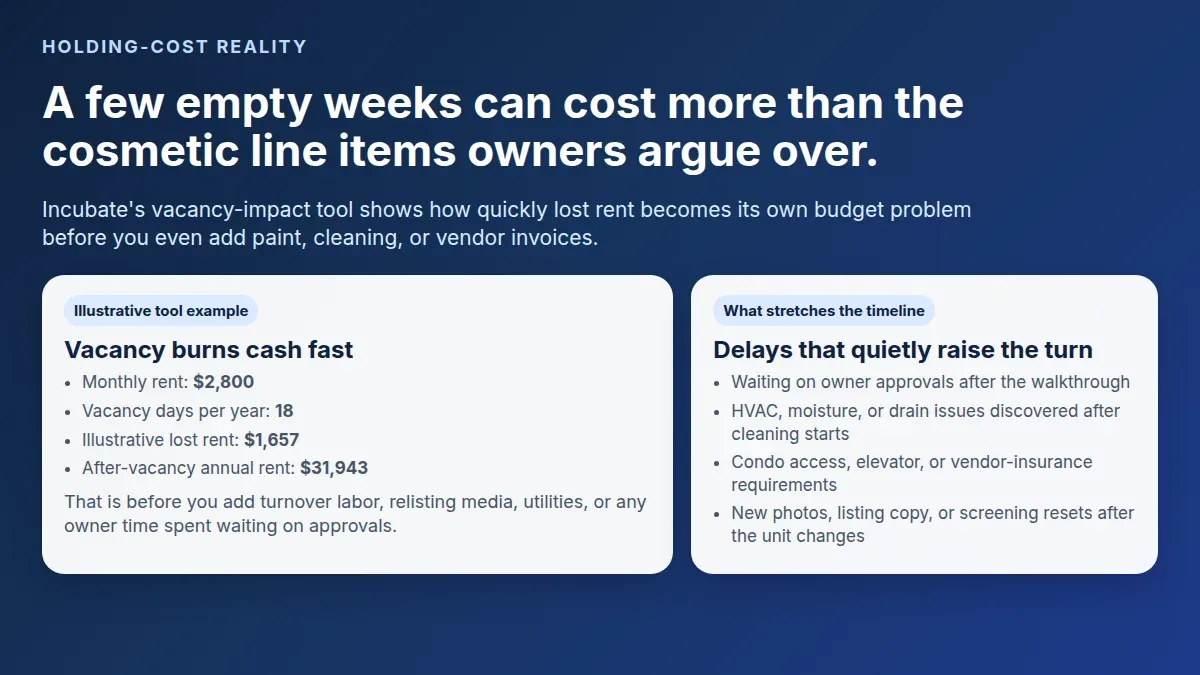 Vacancy is not a background detail. It is often the most expensive line item in the turn because it compounds while owners are still approving "small" scope decisions.
Incubate's rental cash-flow calculator pushes the same lesson from a different angle. It says many investors model vacancy reserves around 5 to 8 percent of gross rent, model maintenance around 5 to 10 percent of effective gross income, and carry an illustrative annual leasing or turnover reserve of $400. Those are planning inputs, not promises. They are still useful because they force the owner to acknowledge that turnover is not a zero-cost event even in a well-run year.
This is where the budget should become formula-driven instead of emotional:
- Vacancy loss: monthly rent x expected empty days / roughly 30.4 days
- Utility carry: estimated bills for the vacancy period plus any restart or transfer friction
- Relaunch cost: photos, listing refresh, screening setup, placement fee, or owner time you would otherwise underprice
- Visible make-ready: the actual contractor and cleaning scopes you already know about
If the visible make-ready work feels annoying, but the unit sits empty for weeks while approvals drag, the vacancy line will often outgrow the repair line.
What South Florida climate and building type add to the budget
South Florida turns do not happen in a neutral environment. Climate and building type change the risk profile.
Incubate's maintenance page says clogged AC drain lines are the number one cause of interior water damage in Florida. It also says South Florida maintenance plans should pay attention to humidity and moisture control, regular filter changes, drain-line flushes, and storm-prep workflow. That is a budget note, not just a maintenance note. The more humid the unit, the less room you have for "we will check that later" thinking between move-out and relist.
The building type matters too. Incubate's turnover checklist reminds owners that condos, townhomes, and association-governed communities can add elevator reservations, move fees, parking decals, certificates of insurance for vendors, and other approval friction. None of those details sound dramatic when you say them out loud. They become expensive when they block access or push the photo and listing relaunch into the next week.
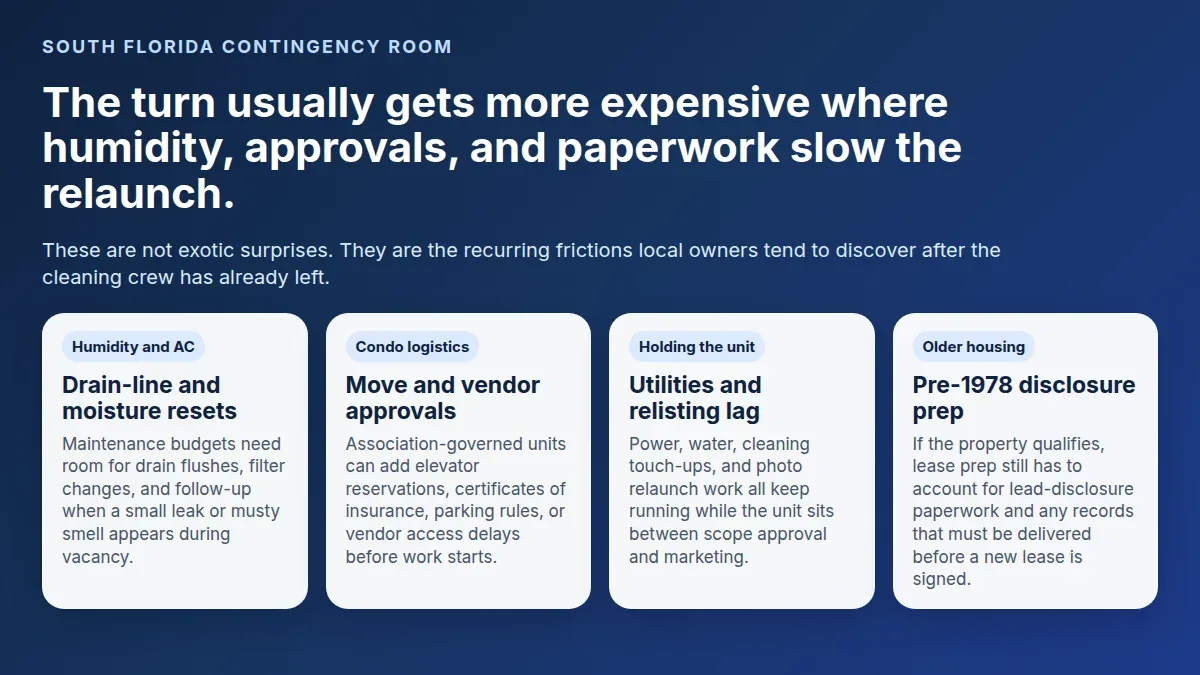 The contingency bucket is where local ownership discipline shows up. South Florida turns are rarely derailed by one giant surprise; they are usually slowed by three or four smaller ones at the same time.
That is why a South Florida contingency line deserves its own bucket instead of getting sprinkled invisibly across other categories. The contingency line is not permission to be sloppy. It is protection against the predictable local frictions that show up after the walkthrough:
- AC or moisture follow-up after a "simple" cleaning turn
- association access rules that slow vendor entry or move scheduling
- extra utility carry while drying, cleaning, or relisting drags out
- small upgrades that become necessary once the unit is photographed or shown
For many owners, the right question is not "Will I have a surprise?" It is "How much room should I carry for the surprise I do not know yet?"
The compliance and handoff items owners still need to price
Some turnover costs are not repair costs at all. They are compliance or documentation costs that still take time and money to handle correctly.
Florida's section 83.51 is a good reminder that landlord-side maintenance obligations do not disappear because a tenant moved out. The statute says landlords must keep plumbing in reasonable working condition, and for many dwelling units it also requires reasonable provisions for locks and keys unless the parties agreed otherwise in writing. For single-family homes or duplexes, it also requires working smoke detection devices at the start of the tenancy. That means some turnover line items are not cosmetic upgrades. They are part of handing the unit back in a condition ready for lawful occupancy.
Older housing can add another prep layer. Under the federal lead-disclosure rule for target housing, landlords leasing most pre-1978 residential property must provide a lead hazard pamphlet, disclose known lead-based paint or lead hazards, provide available records or reports, and attach the required warning and disclosure language before the lease is signed. If your property falls into that category, the relaunch timeline should account for the paperwork and records review instead of pretending lease prep begins after the applicant is already chosen.
The handoff side matters too. Incubate's leasing page says the team drafts legally compliant leases and performs detailed move-in inspections with date-stamped photos and videos. Whether you outsource that work or do it yourself, it belongs in the turnover budget because it protects the next lease cycle. Move-in documentation is not a decorative extra. It is part of reducing future disputes about condition, deposit deductions, and maintenance history.
A sample turnover budget worksheet owners can adapt
The goal of a worksheet is not to predict the exact number for every property. The goal is to keep the owner from approving visible work while forgetting the rest of the turn.
Use a sheet like this before the walkthrough closes:
| Budget line | How to estimate it | Why it belongs |
|---|---|---|
| Vacancy loss | Monthly rent x planned empty days / 30.4 | This is often the largest invisible cost in the turn |
| Utility carry | Recent utility bills x expected vacancy weeks | Showings, cleaners, and vendors still need a functioning property |
| Visible make-ready scope | Cleaning, paint, flooring, lock changes, obvious repairs from the move-out walk | The traditional punch-list category |
| HVAC and moisture reset | Filter change, drain-line flush, moisture check, small follow-up work | South Florida climate turns these into relist protectors, not luxuries |
| Relaunch cost | Photography, listing update, syndication support, placement or screening admin | The unit is not producing again until the next listing is live and usable |
| Compliance and handoff items | Lease prep, move-in inspection workflow, smoke-device or disclosure items where applicable | These steps protect the next lease and often take more time than owners expect |
| Contingency reserve | Fixed reserve, or a percentage layered on top of visible scope | Gives the schedule room when the second-round issue appears |
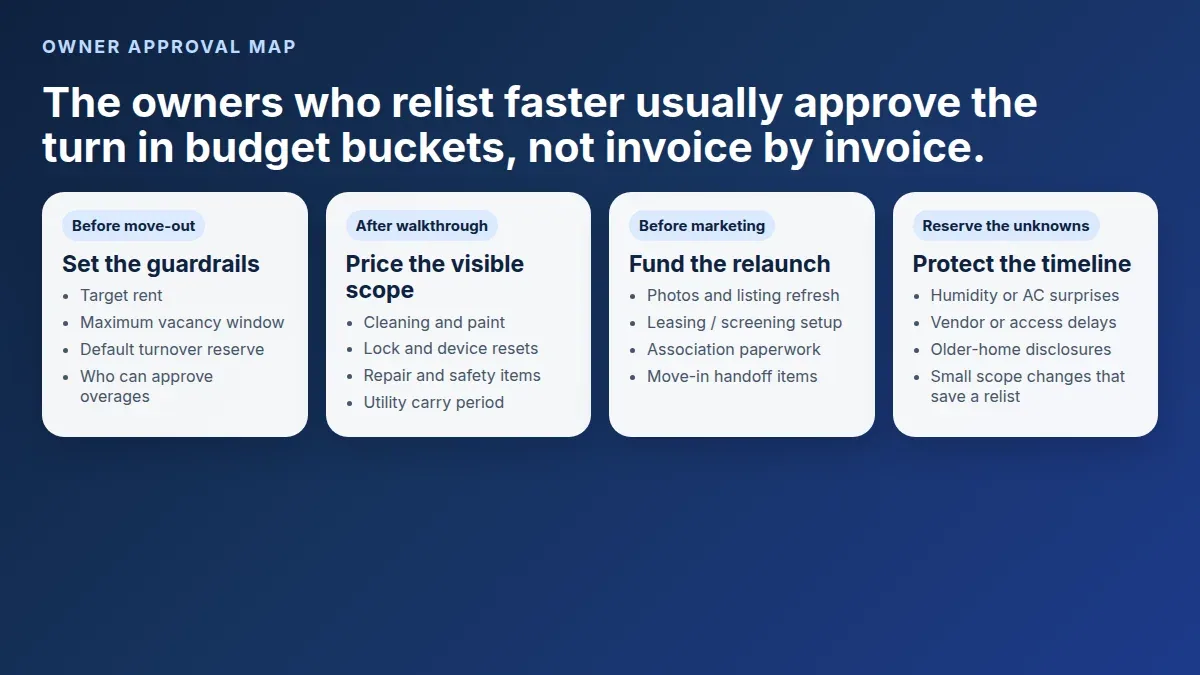 The relaunch moves faster when the owner approves the budget in buckets. Waiting to bless every small invoice one at a time usually costs more than it saves.
One practical rule helps here: approve the budget in phases instead of treating every invoice like a separate debate. Set the guardrails before move-out, price the visible scope after the walkthrough, fund the relaunch before the listing team waits on you, and keep a contingency bucket large enough to protect the vacancy timeline.
How Incubate's workflow changes the math
Professional management does not make turnover free. It can make the budget more honest and the schedule shorter.
Incubate's published workflow shows why. The maintenance side is built around photo-backed portal requests, triage, licensed and insured vendors, and owner visibility into work orders and invoices. The leasing side is built around photography, marketing, screening, lease preparation, and move-in documentation. The rent-collection side is built around direct deposit after rent clears and owner-ledger visibility. That matters because a clean turn depends on the handoff between those systems, not just on one contractor finishing one repair.
For an owner, the value is usually not "someone else pays the bills." The value is that the next steps do not stall as easily:
- vendor scope gets captured faster
- maintenance and relaunch tasks live in one workflow
- the unit can be remarketed with less guesswork
- the next lease file starts with better documentation discipline
That does not mean every owner needs full management. It does mean every owner benefits from running the turn like an operating workflow instead of a loose collection of errands.
If you want to pressure-test your own assumptions, start with Incubate's rental cash-flow calculator and vacancy-impact tool, then compare those assumptions against the live rental property owners workflow and use the contact page if you want a local rental-analysis conversation before the next turn.
This article is general educational information only. Contractor scope, association rules, disclosure duties, and landlord obligations vary by property and situation, so confirm important details with qualified local professionals and the official sources before you rely on one checklist or one budget model.