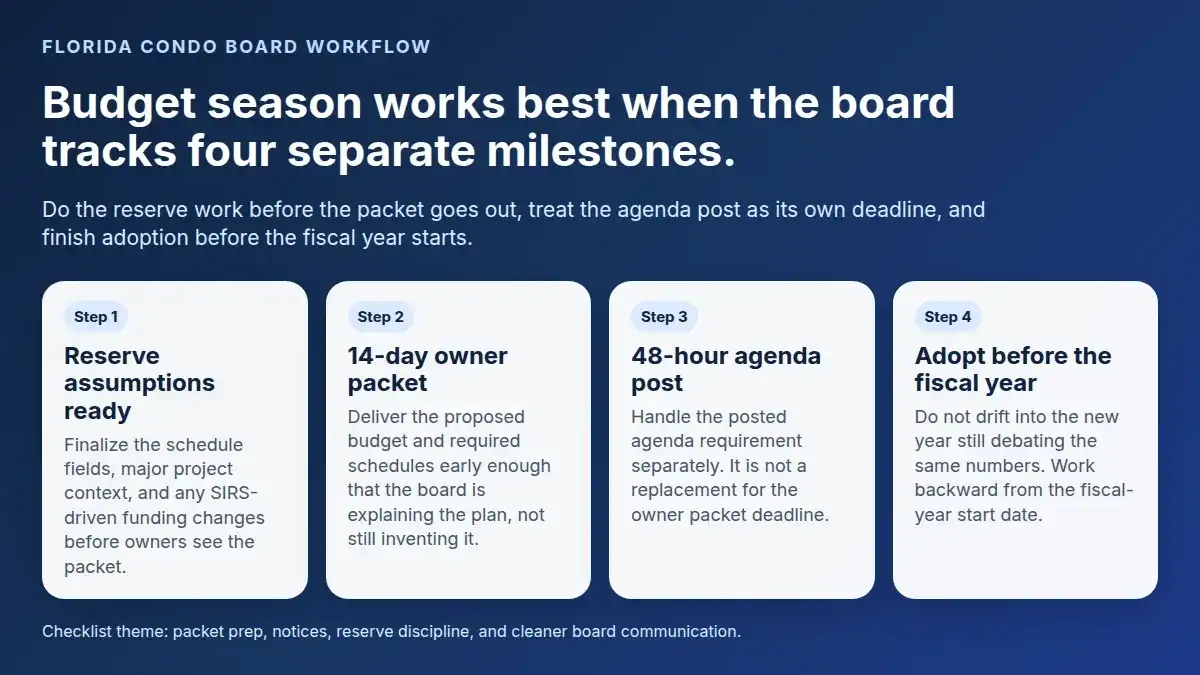
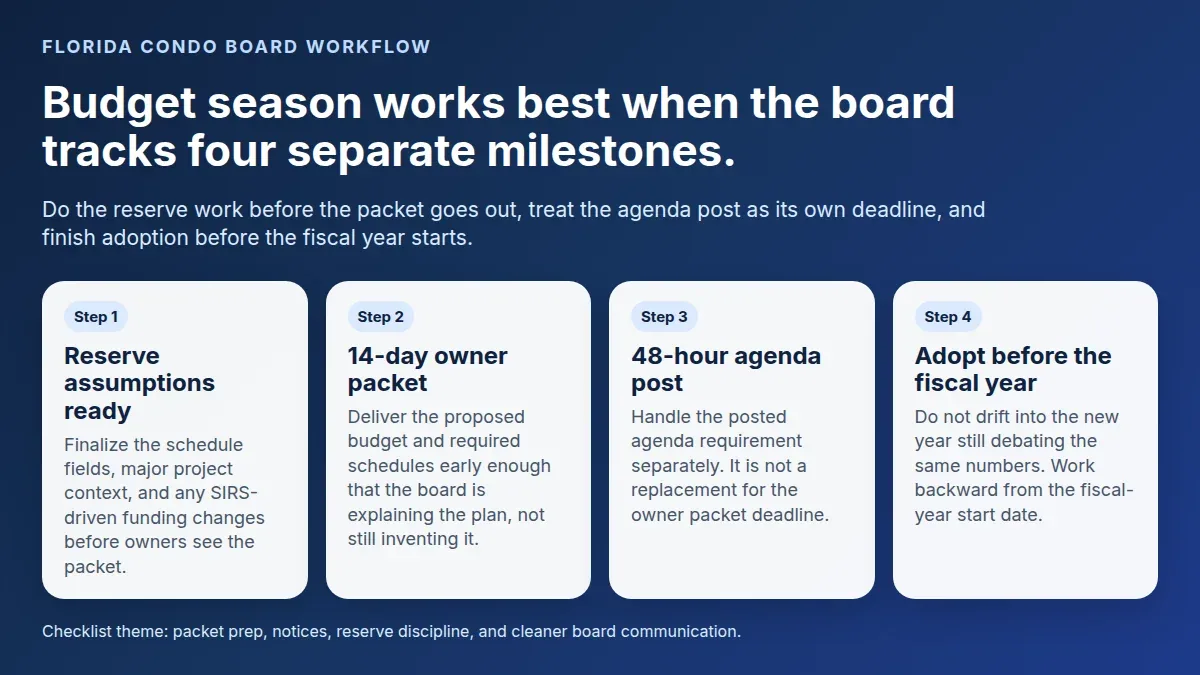
 Budget season feels chaotic when boards treat it as one meeting on one night. The real work starts earlier: packet prep, reserve assumptions, notice timing, and a clear record of how the board got to the final numbers.
A Florida condo budget meeting checklist 2026 is useful only if it separates three different clocks: the 48-hour posted agenda, the 14-day owner packet, and the requirement to adopt the budget at least 14 days before the fiscal year begins. Boards that mash those together usually discover the missing piece too late, after owners are already frustrated, reserve questions are still unresolved, or the manager is scrambling to finish affidavits and minutes.
That is why this topic is more operational than legalistic. Section 718.112, Rule 61B-22.003, and the DBPR Chapter 718 financial-information guide give boards the deadlines and required budget structure. What they do not do is organize the workflow for a board packet, reserve schedule review, owner communication, and adoption meeting that still feels under control once budget season is already moving.
If you need the legal backdrop first, start with Incubate PM's 2024 Florida condo law explainer. If you want the broader operating list beyond budget season, use the condo association management checklist. This page is the narrower budget-meeting workflow: the 48-hour posted agenda, the 14-day owner packet, and adoption before the fiscal year begins. Incubate PM's South Florida condo association management pages are useful in that gap because they frame the real pressure points honestly: reserve requirements, meeting support, official records, owner communication, vendor coordination, and the financial visibility boards need before they can defend a budget. This guide translates that legal-and-operational mix into a practical board checklist. It is general educational information, not legal, reserve-study, or accounting advice for a specific association.
Why budget season becomes a board problem before the meeting starts
A condo budget meeting rarely goes sideways because the board forgot to schedule one hour on the calendar. It goes sideways because the important work was still unsettled when the notice window arrived.
By the time owners see a proposed budget, they are not only reacting to one final assessment number. They are reacting to everything behind it: whether the reserve lines make sense, whether major repairs are being handled transparently, whether the packet explains the delinquencies and vendor costs they have been hearing about all year, and whether the board seems organized enough to answer questions without improvising. When that preparation is weak, the meeting becomes the place where the board is trying to finish the budget instead of present it.
That is also why this is a natural Incubate topic. The firm's condo services scope page emphasizes board support, owner communications, records, meeting prep, vendor oversight, and monthly financial reporting as one connected service stack. The financial reporting page adds the monthly pieces boards actually need before budget season: income and expense reports, cash-flow visibility, general-ledger detail, invoice backup, expense categorization, and reserve-planning support. Those are not decorative back-office tasks. They are the raw materials for a budget packet that does not collapse under scrutiny.
The practical mindset shift is simple. Do not treat the meeting date as the start of budget season. Treat it as the last visible checkpoint in a records-and-communication process that should already be mostly finished.
The three deadlines boards cannot collapse into one
The most annoying version of this topic is the one that says "give 14 days' notice" and stops there. That is how boards miss the separate posting and adoption requirements.
Under section 718.112, a residential condominium board should think in three timing layers:
| Timing layer | What the rule covers | Why it matters in practice |
|---|---|---|
| At least 48 continuous hours before the board meeting | The agenda notice for a board meeting must be posted conspicuously on the property, except in an emergency. | This is the short-window operational reminder. It is not a substitute for the owner packet. |
| At least 14 days before the budget meeting | Owners must receive notice of the meeting and a copy of the proposed annual budget, and the association should keep an affidavit showing compliance in the official records. | This is the packet-delivery deadline. If the reserve schedules or summary explanations are not ready, the board is already late. |
| At least 14 days before the fiscal year begins | The board must adopt the annual budget before the association enters the new fiscal year. | This is the backward-planning deadline that prevents "we will finish it next week" drift. |
A budget meeting must also be open to all unit owners. The statute allows the meeting to be conducted by video conference, but only if a sound-transmitting setup lets in-person attendees and owners hear the conversation. That matters because a video option does not reduce the preparation burden. If anything, it raises the pressure on packet clarity because owners have fewer informal hallway opportunities to ask what a reserve jump or line-item change actually means.
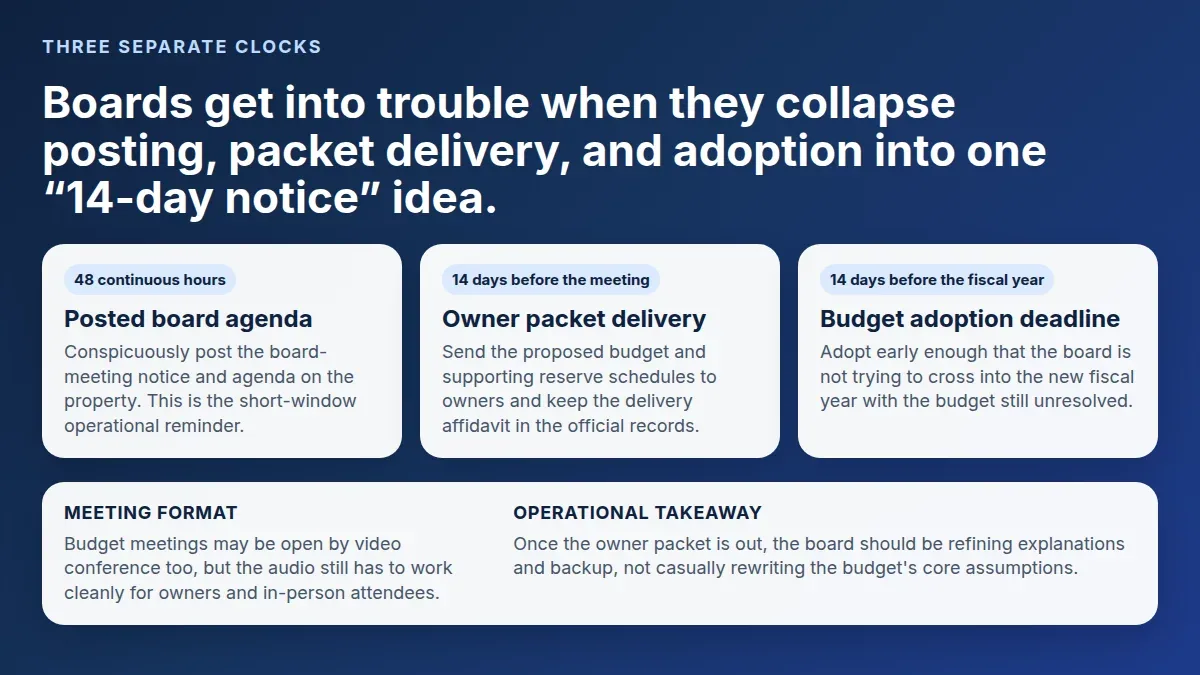 The useful timeline is not one notice date. It is a chain: final reserve assumptions, owner packet delivery, posted agenda, then adoption before the fiscal year rolls over.
One more nuance matters here. Some boards talk as if the 14-day packet delivery requirement means they can still be "working through" the budget internally during those two weeks. That is risky. Once the packet goes out, the board should be refining presentation and owner communication, not changing core assumptions casually. If major revisions still feel likely, that is a sign the working timeline started too late.
What the proposed budget packet has to show before owners see it
A board does not need a dramatic presentation deck to survive budget season. It does need a proposed budget packet that is detailed enough to answer predictable questions before the room gets tense.
Section 718.112 says the proposed annual budget must show estimated revenues and expenses by accounts and expense classifications. The budget also must include reserve accounts for capital expenditures and deferred maintenance. For Florida condo boards, that usually means more than one generic line called "reserves."
The cleaner reading is to build the packet in layers.
First comes the operating side: the recurring revenue and expense story owners expect to see. That is where boards should already understand the lines driving the year-over-year change rather than discover them while reading the packet aloud.
Second comes the reserve side. Rule 61B-22.003 says that if reserves are not pooled, each reserve account should be shown as a separate line item with four core disclosures:
- total estimated useful life of the asset
- estimated remaining useful life
- estimated replacement cost or deferred-maintenance expense
- estimated fund balance at the start of the budget period
If the association uses pooled reserves, the rule still expects a separate schedule. The difference is that the schedule should show the assumptions for each asset within the pool and the pooled reserve balance at the beginning of the budget period. Either way, the reserve story has to be readable enough that directors can explain not only the funding number, but the assumptions underneath it.
The DBPR guide reinforces another point boards sometimes miss: reserve schedules should travel with the budget notice sent to owners. They are not an optional appendix to bring only if someone asks.
That is where boards usually benefit from a pre-meeting packet review session with management. A practical packet should make it easy to answer questions such as:
- Which expense lines changed materially from the current year, and why?
- Which reserve assumptions came from the most recent study versus a board judgment call?
- Which capital or deferred-maintenance items are driving the largest increase?
- Are there contracts, invoices, or project notes ready if owners challenge the logic behind a line item?
- If collections or delinquencies are affecting cash flow, is the board prepared to explain that separately from the reserve story?
In other words, packet prep is not only formatting. It is the meeting rehearsal the board should do before owners ever see the numbers.
Where the 115 percent rule and SIRS funding change the conversation
The detail many boards and owners find late is the 115 percent rule.
Section 718.112 says that if the proposed annual budget requires assessments that exceed 115 percent of the prior fiscal year's assessments, the board must simultaneously propose a substitute budget that excludes discretionary expenditures not required to be in the budget. That does not automatically mean the substitute budget will be adopted. It does mean the board has a second conversation to prepare for, and that conversation can get messy if nobody tested the threshold before the packet went out.
Just as important, the statute does not treat every increase the same way when calculating the threshold. Required reserve provisions, certain nonregular repair or replacement expenses for listed items, and insurance premiums are excluded from that 115 percent comparison. Boards that forget the exclusions can misread whether the trigger applies. Boards that ignore the trigger entirely can create an avoidable process problem even when the underlying budget rationale is sound.
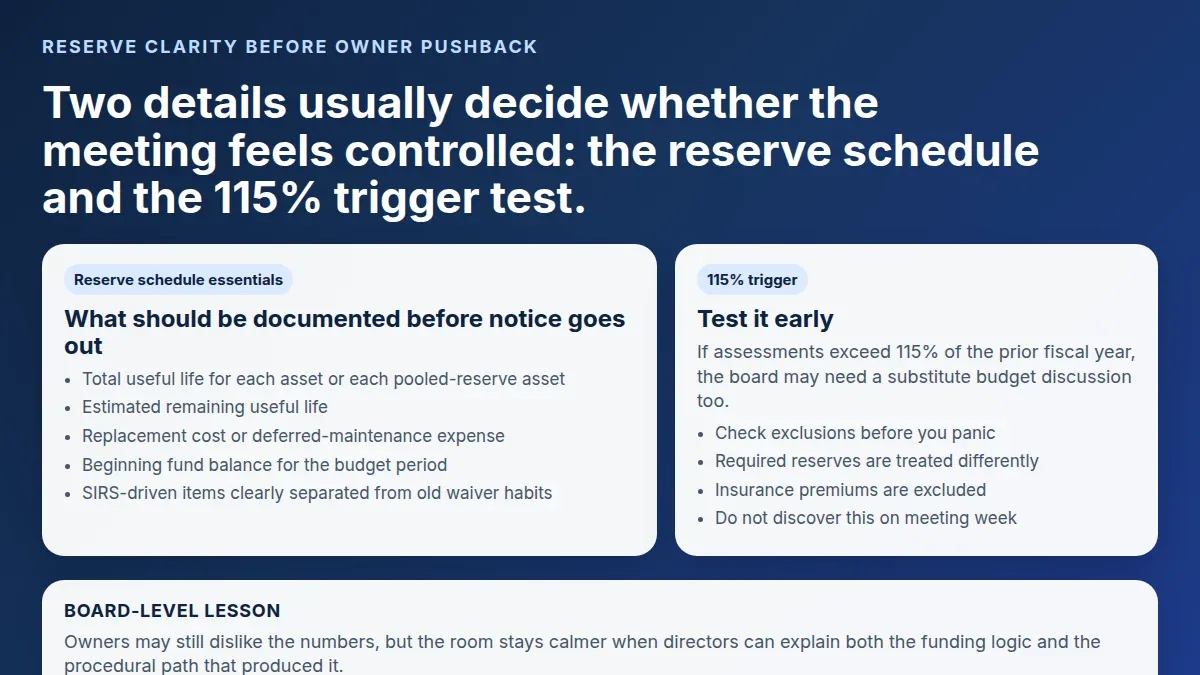 The hard questions usually live in two places: whether the reserve assumptions are documented well enough, and whether the board tested the 115 percent trigger before the packet was finalized.
Reserve funding has become even less forgiving for many condominium boards because SIRS-driven items changed the old "we will waive reserves this year" mindset. For budgets adopted on or after December 31, 2024, unit-owner-controlled associations that must obtain a structural integrity reserve study generally may not vote to provide no reserves or less reserves than required for the listed structural items, except in a narrow multicondominium alternative-funding scenario approved by the division. That is a polite way of saying some old board habits are no longer available.
There is also a narrow temporary exception boards should understand without overusing: for budgets adopted on or before December 31, 2028, an association that completed a milestone inspection within the previous two calendar years may, with majority approval, temporarily pause or reduce reserve contributions for up to two annual budgets to fund recommended repairs. Useful? Sometimes. A substitute for budget discipline? No. If a board uses that exception, it still needs a clear explanation of what is being funded, why the pause exists, and how the reserve plan restarts.
The broader operating lesson is that reserve decisions should be settled before the budget packet goes out, not discovered mid-meeting. Owners may disagree with the answer, but they should at least be able to see that the answer came from a documented process.
How a management partner changes the workflow
Most boards do not lose control of budget season because they lack opinions. They lose control because the records, notices, explanations, and follow-up tasks live in too many places at once.
This is where a management partner can materially change the outcome. Incubate's condo-management pages describe the work in the right order: monthly financial visibility, official-record discipline, board support, meeting preparation, owner communication, and reserve-planning context. The value is not only that someone knows the statute exists. The value is that the board packet, delivery proof, line-item backup, vendor context, and meeting materials can move through one workflow instead of six disconnected inboxes.
Incubate's financial reporting page is especially relevant here because it frames the monthly accounting output as always-on board infrastructure rather than year-end cleanup. If directors can see income and expense reporting, cash flow, general-ledger detail, invoice backup, and reserve-related context each month, budget season becomes an explanation exercise instead of a reconstruction project.
Boards shopping for help should pressure-test that claim directly. Ask a prospective manager:
- Where do the proposed and adopted budgets live after the meeting?
- Who prepares the owner packet and tracks the affidavit or proof of delivery?
- How are reserve assumptions documented when the board asks for revisions?
- What backup is available if owners question a major vendor, project, or expense line?
- How are budget-meeting minutes and supporting files retained in the official records?
Those answers matter more than a glossy promise about "full service." Budget season exposes whether the manager has a repeatable board process or only a collection of tasks.
A 30-day board checklist before the adoption meeting
If your association's budget meeting is roughly one month out, this is the cleanest sequence to follow.
- Confirm the fiscal-year start date and work backward immediately. If the budget must be adopted at least 14 days before the new fiscal year, the board should know the last safe adoption date before any notices are drafted.
- Decide whether the reserve assumptions are final enough for owner review. If the most recent reserve or SIRS inputs are still moving, fix that first. The packet should not go out while the most controversial line items are still guesses.
- Test the 115 percent rule before the packet is finalized. Do not discover on meeting week that a substitute budget should have been prepared too.
- Assemble the reserve schedules in the correct format. Whether the association uses separate or pooled reserves, the required useful-life, cost, and beginning-balance fields should be easy to follow.
- Prepare the owner's explanatory backup. Owners do not need every invoice in the packet, but the board should have backup ready for major assessment drivers, repairs, delinquencies, and reserve changes.
- Send the 14-day meeting notice with the proposed budget and required schedules. Keep the affidavit or other proof of compliance with the official records.
- Handle the 48-hour posted agenda requirement separately. This is its own board-meeting notice step, not a reminder to finish the packet late.
- Plan the post-meeting records work. Rule 61B-22.003 says the minutes should reflect adoption, and copies of both the proposed and adopted budgets should be maintained in the financial records.
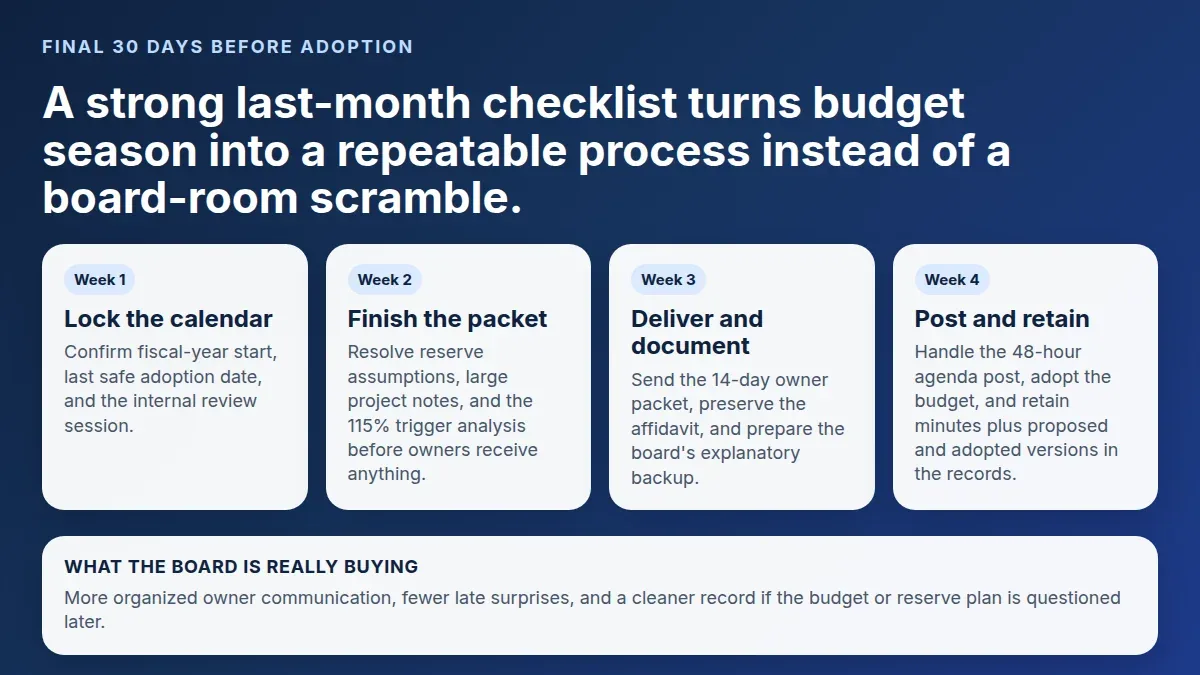 The goal of the last 30 days is not to invent the budget under pressure. It is to make sure the numbers, records, notices, and owner explanations stay aligned all the way through adoption.
A board can still have a difficult meeting after following that checklist. Owners may dislike the increase. Reserve funding may still feel painful. Large repairs may still be unpopular. But the discussion is much healthier when the process is orderly and the record is defensible.
If your association wants help tightening that process, start with Incubate PM's condo-management resources and use the contact page to compare your current budget workflow against a manager-led one.
This article is general educational information only. Condominium bylaws, fiscal-year timing, reserve studies, project history, and legal obligations vary by association, so confirm important decisions with qualified counsel, accountants, reserve professionals, and the relevant official Florida sources before acting.